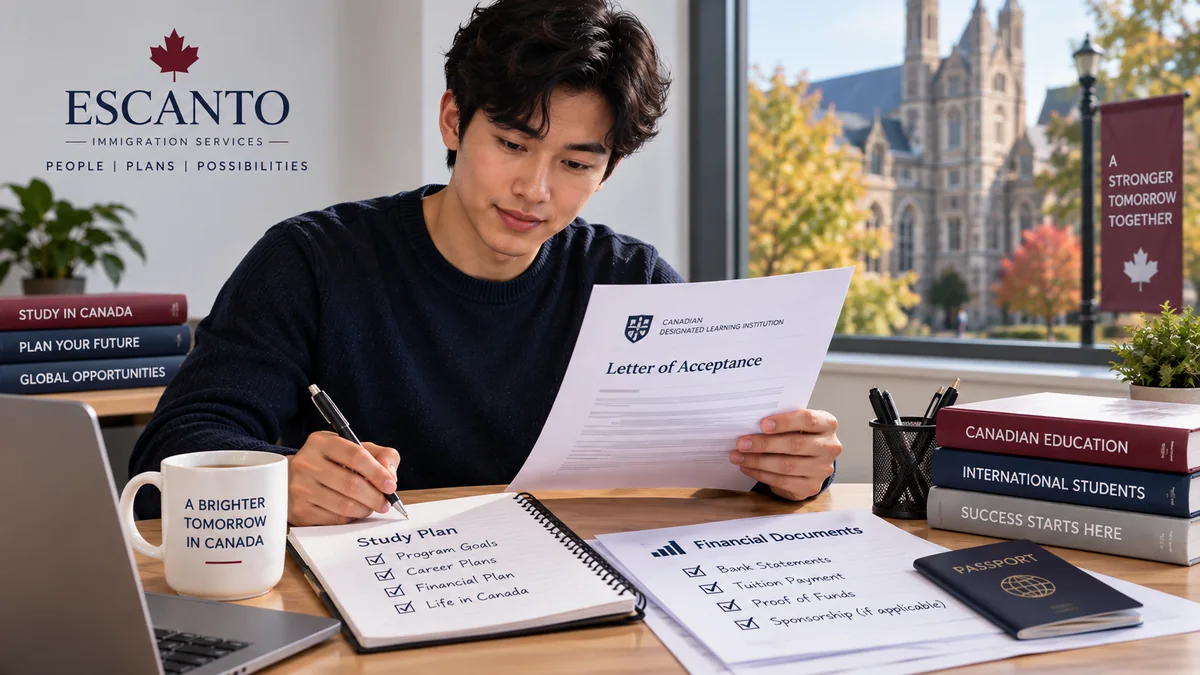
Admission to a Canadian school is only the first step
Receiving an offer of admission from a Canadian educational institution can be significant, but admission alone does not establish eligibility for a study permit.
IRCC currently requires study permit applicants to be enrolled at a designated learning institution (DLI), demonstrate sufficient financial resources, satisfy applicable health and admissibility requirements, and establish to an immigration officer that they will leave Canada when their authorized stay ends.
The study permit application therefore involves two different assessments:
- the academic institution has accepted the applicant, and
- the applicant satisfies Canada’s immigration requirements to study temporarily in Canada.
A well-prepared application should address both.
The Letter of Acceptance is fundamental
A study permit applicant generally needs a valid Letter of Acceptance, commonly called an LOA, from the designated learning institution they intend to attend.
IRCC identifies the LOA as an application document that is always required unless a particular exemption applies. For post-secondary applications, IRCC may also ask the institution to validate the LOA; if the school does not validate it within the required period, the application can be returned.
Applicants should therefore verify:
- the correct school name;
- the program;
- academic level;
- program start and end dates;
- tuition;
- campus, where relevant; and
- whether the institution and program fit the applicant’s immigration objectives.
Admission to a DLI should not be confused with eligibility for every benefit associated with international study in Canada.
DLI status and post-graduation work eligibility are separate questions
A school may be a designated learning institution without every program at that school necessarily leading to eligibility for a post-graduation work permit (PGWP).
IRCC expressly states that graduating from a DLI does not automatically make someone eligible for a PGWP. Applicants contemplating post-study employment should therefore check both the institution and the particular program before enrolling.
This distinction can be important where a student’s longer-term plan depends on gaining Canadian work experience after graduation.
Do you need a provincial or territorial attestation letter?
Many study permit applicants must submit a Provincial Attestation Letter or Territorial Attestation Letter, commonly called a PAL or TAL.
IRCC describes a PAL/TAL as confirmation from the province or territory that space exists for the applicant within the applicable international student allocation. It is generally obtained through the DLI and is usually required with the study permit application unless the applicant falls within an exemption.
The rules have changed over time, so applicants should not rely on older checklists.
For 2026, IRCC identifies exemptions including certain primary and secondary students and, beginning January 1, 2026, students entering eligible master’s and doctoral degree programs at public DLIs. Applicants studying in Quebec must also consider Quebec’s separate provincial requirements.
The appropriate question is therefore not simply:
“Do international students need a PAL?”
but:
“Does this particular applicant, program and institution require one at the time of application?”
Financial capacity is a core part of the application
A study permit applicant must demonstrate that they have sufficient resources without relying on future employment in Canada to pay for:
- tuition;
- living expenses for themselves and accompanying family members; and
- transportation to and from Canada.
For programs lasting more than one year, IRCC also expects applicants to explain how they plan to finance the remainder of their studies beyond the first year.
Financial planning should therefore cover the entire academic plan rather than only the minimum amount required to submit the application.
The living-expense requirement changed in September 2026
IRCC periodically updates the minimum financial-capacity amounts.
For applications made on or after September 1, 2026, an applicant studying outside Quebec must currently demonstrate CAD 23,448 for one person for one year of living expenses, excluding tuition and transportation.
The amounts increase where accompanying family members are included. Quebec uses separate financial requirements.
Because these figures are updated, applicants should verify the current IRCC table immediately before filing rather than relying on an older article, school handout or previous application.
A bank balance alone may not tell the whole financial story
IRCC’s current guidance emphasizes both the amount of funds and their source and availability.
Examples of supporting financial documents can include:
- tuition or housing payment receipts;
- education loans;
- scholarships;
- recent pay stubs;
- evidence from a person financially supporting the applicant;
- Canadian or foreign bank accounts;
- guaranteed investment certificates;
- pension income;
- rental income; and
- other evidence appropriate to the applicant’s circumstances.
IRCC currently identifies six months of bank statements as one form of evidence and notes that documentation should explain the source of income reflected in those statements.
That makes the history of the funds relevant.
A large amount deposited shortly before an application may require more explanation than funds accumulated consistently through salary, business income, savings or documented family support.
Financial sponsorship should be documented clearly
Some students rely partly or entirely on parents, relatives or another person for financial support.
IRCC’s current guidance contemplates evidence from the supporting person showing matters such as:
- their occupation or employment;
- their relationship to the student;
- the amount of support;
- their dependants;
- identification; and
- evidence establishing that the promised funds are actually available.
The student’s application should make the arrangement understandable.
For example, where a parent will fund tuition and living costs, the evidence should reasonably demonstrate both the parent’s ability to provide that support and the relationship between the parent and applicant.
The letter of explanation matters
IRCC specifically recommends a letter of explanation with a study permit application.
The letter should explain why the applicant wants to study in Canada and demonstrate an understanding of the responsibilities associated with international student status.
This document is sometimes called a:
- study plan;
- statement of purpose;
- letter of explanation; or
- study permit submission letter.
Whatever terminology is used, it should not simply repeat the admission letter.
It should help the officer understand why the proposed studies make sense for this particular applicant.
What should a study plan explain?
A useful study plan often addresses questions such as:
- Why did the applicant choose this program?
- Why this particular Canadian institution?
- How does the program relate to previous education or employment?
- Why is additional study reasonable at this stage of the applicant’s life or career?
- How will the studies be financed?
- What is the applicant’s expected career benefit?
- What circumstances exist outside Canada?
- How does the proposed study fit within a credible temporary immigration plan?
Not every application needs the same emphasis.
A recent high-school graduate applying for an undergraduate degree presents a very different profile from an experienced professional applying for a one-year postgraduate program after a decade in the workforce.
Academic progression should make sense
Immigration law does not require every student to follow one rigid educational progression.
However, where the proposed program appears disconnected from the applicant’s academic or professional background, the application may benefit from a clear explanation.
For example:
- Why is a person with an existing university degree pursuing a college diploma?
- Why is someone changing fields?
- Why is a mid-career professional returning to school?
- Why does the Canadian program provide something relevant that the applicant does not already possess?
There may be perfectly reasonable answers.
The application should explain them rather than assuming the relationship is self-evident.
Previous education and employment should be presented consistently
The information in the study permit application should correspond with:
- transcripts;
- diplomas and degrees;
- employment records;
- résumés where submitted;
- previous visa or permit applications; and
- information previously provided to Canadian immigration authorities.
An application can become difficult to assess where different documents provide substantially different dates, job titles or educational histories.
The objective is not to make an applicant’s history appear ideal.
It is to present the actual history accurately and coherently.
Temporary residence remains part of the assessment
A study permit is temporary resident authorization.
IRCC’s current eligibility criteria require an applicant to satisfy an officer that they will leave Canada when the study permit expires.
This does not mean a student can never become eligible for another Canadian immigration pathway later.
It means that the study permit application itself must satisfy the legal requirements applicable to temporary residence.
Applicants should therefore avoid treating admission to school as though it creates an automatic right to remain permanently in Canada.
Ties outside Canada can form part of the overall context
An applicant’s circumstances outside Canada may help explain the temporary nature and logic of the study plan.
Depending on the individual, relevant circumstances may include:
- family relationships;
- employment history;
- property or financial interests;
- professional opportunities;
- business interests;
- previous education;
- career trajectory; and
- other continuing responsibilities.
There is no universal checklist of “ties” that applies identically to every student.
A young applicant entering university immediately after secondary school will naturally have a different profile from a married professional with established employment and family responsibilities.
Accompanying family members affect the application
Some students plan to travel with a spouse, partner or children.
Their presence can affect:
- the amount of required financial support;
- temporary resident applications for accompanying family members;
- housing and living-cost planning; and
- the overall factual circumstances of the application.
IRCC’s financial-capacity requirements explicitly increase according to the number of accompanying family members.
The immigration status available to an accompanying spouse or partner should also be assessed separately rather than assumed.
Working while studying is subject to conditions
A study permit does not give every student unlimited permission to work.
Eligible international students may currently work up to 24 hours per week off campus during regular academic sessions and may work unlimited hours during qualifying scheduled breaks, provided they continue to meet the applicable requirements.
Students generally cannot begin working before their study program starts.
On-campus work follows its own eligibility rules.
Students should therefore understand the work conditions printed on their permits and the underlying regulatory requirements.
Employment should not be the financial plan for the study permit
The possibility of authorized part-time employment in Canada should not be treated as a substitute for demonstrating sufficient funds.
IRCC’s financial-support requirement expressly requires students to demonstrate enough money for tuition, living expenses and transportation without working in Canada.
An application that depends on anticipated Canadian employment to pay basic tuition or living expenses may therefore conflict with the financial-capacity requirement.
Students must continue meeting permit conditions after arrival
Obtaining the permit is not the end of the immigration obligations.
IRCC currently requires most study permit holders to remain enrolled at a DLI and actively pursue their studies. This generally means maintaining appropriate enrolment and making progress toward completing the program.
Authorized leaves can be permitted in specific circumstances, but IRCC states that such leaves generally cannot exceed 150 days if the student is to remain compliant with the applicable study conditions. Students generally cannot work during an authorized leave.
Applicants should therefore understand not only how to obtain a study permit but also how to maintain their status after arrival.
Changing schools now requires particular attention
International student rules concerning changes of institution have tightened.
IRCC’s current guidance requires students changing schools to comply with the applicable study permit rules, and regulatory changes introduced requirements for international students to obtain authorization through the prescribed process rather than simply moving between DLIs without immigration consequences.
Students considering a transfer should review the current IRCC procedure before changing institutions.
A study permit does not guarantee a post-graduation work permit
This is one of the most important planning issues for prospective international students.
IRCC expressly states:
Graduating from a DLI does not automatically make someone eligible for a PGWP.
Current PGWP requirements vary according to factors including:
- the institution and program;
- program length;
- level of study;
- language results;
- date of the study permit application; and
- for some programs, the field of study.
Applicants whose long-term plans depend on post-graduation employment should investigate those requirements before paying tuition and committing to a program.
PGWP requirements changed significantly after November 2024
Under the current rules, many PGWP applicants must provide qualifying English or French language results.
Bachelor’s, master’s and doctoral graduates do not currently face the PGWP field-of-study requirement, while graduates of certain other programs may need to graduate from an eligible field of study depending on when they applied for their study permit.
IRCC has also stated that the eligible PGWP fields of study are frozen for 2026, meaning no fields are being added or removed during this year.
These rules are policy-sensitive and can change. A prospective student should therefore verify current PGWP eligibility for the exact program rather than relying solely on statements from recruiters or general marketing material.
A post-graduation work permit is an open work permit. For a broader explanation of how open permits differ from employer-specific permits, see Open vs. Employer-Specific Work Permits in Canada: What Is the Difference?
Permanent residence is a separate assessment
Canadian education can be relevant to future immigration options, but completing a Canadian program does not automatically create permanent residence eligibility.
Future pathways may depend on factors such as:
- age;
- language proficiency;
- Canadian and foreign work experience;
- occupation;
- provincial programs;
- Express Entry eligibility and ranking;
- family circumstances; and
- immigration rules in effect at that later time.
Students should distinguish between:
permission to study,
permission to work after graduation, and
eligibility for permanent residence.
They are related in some cases, but legally they are separate immigration questions.
Applicants considering permanent residence after their studies may also wish to review How Express Entry Works in Canada: Eligibility, CRS and the Application Process.
Avoid choosing a program solely because of immigration marketing
Prospective students sometimes encounter advertisements describing a program as a guaranteed path to work authorization or permanent residence.
That approach creates risk because immigration programs and eligibility criteria can change.
A more careful analysis asks:
- Is the institution a DLI?
- Is the exact program PGWP-eligible?
- Do current field-of-study requirements apply?
- Does the program make academic and career sense?
- Can the applicant finance the studies?
- Does the study plan make sense given the applicant’s background?
- What would the applicant’s immigration options be if future policies changed?
Education should remain a genuine educational decision, even when immigration planning is also relevant.
Common weaknesses in study permit applications
A generic study plan
A letter that could apply to any student and any school does little to explain why this particular program is reasonable for this applicant.
Unexplained academic change
Changing direction can be legitimate, but a major shift in level or field may need explanation.
Financial evidence without a clear source
A substantial balance may raise questions if the application does not explain where the funds came from and whether they are genuinely available.
Depending on Canadian employment to finance the program
IRCC requires sufficient financial capacity without depending on work in Canada.
Assuming PGWP eligibility
DLI status and PGWP eligibility are not the same.
Outdated PAL/TAL information
Requirements and exemptions have changed, including new 2026 exemptions for certain graduate students at public DLIs.
Inconsistent information
Education, employment, travel and financial histories should align with the supporting evidence and previous immigration records.
A practical study permit preparation checklist
Before filing, an applicant should be able to answer:
- Is the school a designated learning institution?
- Is the Letter of Acceptance valid and accurate?
- Is a PAL/TAL required?
- If studying in Quebec, have the applicable Quebec requirements been addressed?
- Can the applicant demonstrate first-year tuition, living costs and transportation?
- Is there a credible plan for financing later years?
- Are the source and availability of funds documented?
- Does the proposed program make sense given the applicant’s education and career?
- Does the letter of explanation address the actual circumstances rather than using generic language?
- Are accompanying family members properly accounted for?
- If post-graduation employment is important, has the exact program’s PGWP eligibility been verified?
- Are the application forms and supporting documents internally consistent?
A study permit application should be assembled around those substantive questions, not merely around the upload fields in the online portal.
Getting advice about studying in Canada
Escanto Immigration Services assists prospective international students with assessing study permit eligibility, reviewing study plans, financial documentation and supporting evidence, and preparing Canadian study permit applications.
For an overview of this area, see our Study in Canada service.
Applicants whose plans also involve future employment should review the separate requirements discussed in our Insight Open vs. Employer-Specific Work Permits in Canada: What Is the Difference?
For advice based on your educational background, proposed program, finances and immigration history, book a consultation.
Explore more Canadian immigration information and practical guidance in Escanto Insights.