What is the Federal Skilled Worker Program?
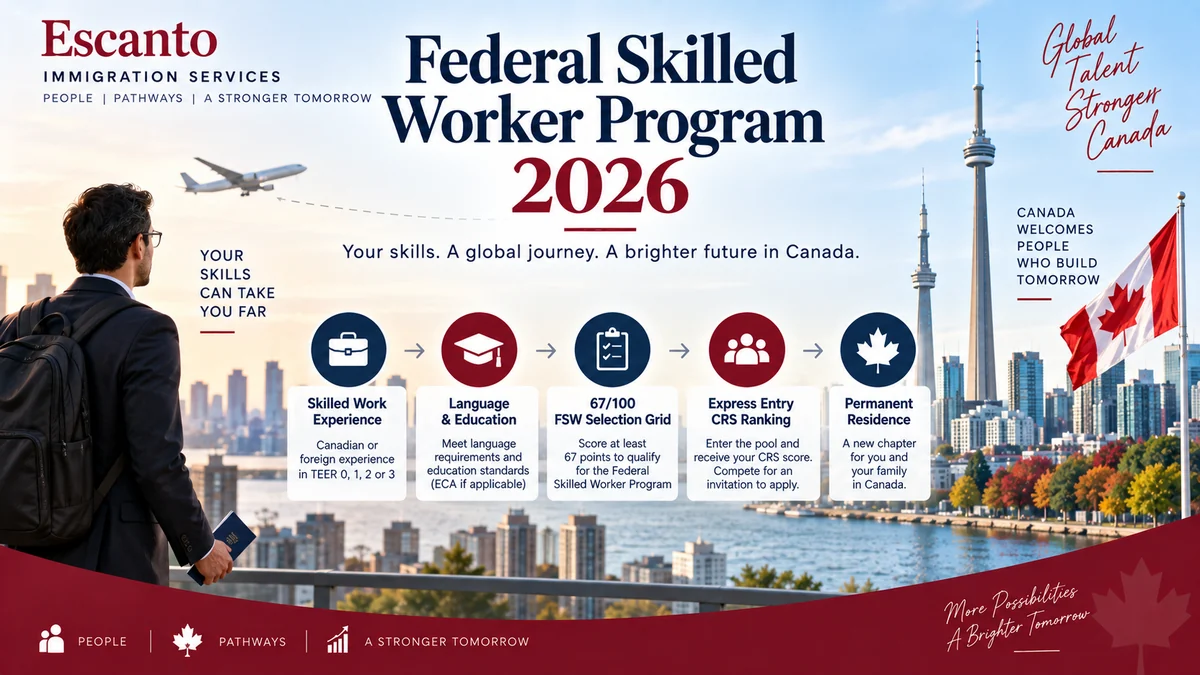
The Federal Skilled Worker Program (FSWP) is one of the three federal economic immigration programs managed through Canada’s Express Entry system.
It is particularly important for skilled workers who may have substantial professional experience outside Canada.
Unlike the Canadian Experience Class, the FSWP does not require the applicant to have previously worked in Canada. Qualifying work experience can have been obtained either in Canada or abroad.
However, becoming eligible for the Federal Skilled Worker Program is only the first stage.
An applicant must first satisfy the program’s minimum requirements and obtain at least 67 points out of 100 under the FSW selection-factor grid. Once eligible to enter Express Entry, the candidate receives a separate Comprehensive Ranking System (CRS) score and competes for an Invitation to Apply.
That creates two separate point systems:
FSW 67-point grid → determines program eligibility
CRS score → determines ranking in the Express Entry pool
Confusing these two systems is one of the most common Express Entry mistakes.
The basic Federal Skilled Worker requirements
Under IRCC’s current rules, the applicant must satisfy minimum requirements relating to skilled work experience, language ability and education. If those requirements are met, IRCC then applies the 100-point Federal Skilled Worker selection grid.
The applicant must also be admissible to Canada and generally intend to live outside Quebec, because Quebec selects its own skilled workers. Qualifying work experience obtained while living in Quebec can potentially count if the applicant can demonstrate an intention to settle elsewhere in Canada.
Skilled work experience
The applicant’s qualifying work experience must be in a National Occupational Classification occupation classified as:
TEER 0, 1, 2 or 3.
IRCC requires the applicant to identify a primary occupation for the FSW application. That primary occupation does not necessarily have to be the applicant’s most recent job.
The qualifying experience must have been obtained within the 10 years before the application and must have been paid through wages or commission. Volunteer work and unpaid internships do not satisfy the minimum requirement.
One year of continuous skilled work is required
The minimum is:
one year of continuous work
or
1,560 hours of qualifying employment.
IRCC uses 30 hours per week as the full-time maximum for this calculation. Hours above 30 per week do not accelerate the one-year requirement.
A person cannot therefore work 60 hours per week for six months and claim that as the equivalent of one year for the FSW minimum.
Part-time employment can qualify, but the required experience must still satisfy the program’s continuity requirements.
The work must be in the same primary NOC
For the minimum FSW work-experience requirement, the qualifying period must be in the same NOC selected as the applicant’s primary occupation.
This is different from the Canadian Experience Class, where qualifying skilled Canadian work may be accumulated across more than one eligible NOC.
An applicant with many years of professional experience should therefore identify which occupation provides the strongest qualifying continuous period rather than simply combining unrelated skilled jobs.
Job title is not enough
IRCC requires the applicant’s experience to show that they performed:
- the actions described in the NOC lead statement; and
- most of the main duties listed for the occupation.
The actual work performed matters more than the title printed on a business card.
For example, a person called a “Director” internally may not necessarily qualify under a senior-management NOC if the actual responsibilities align more closely with another occupation.
NOC classification should therefore be based on duties, responsibilities and occupational context rather than prestige of title.
Can work completed while studying count?
Unlike the Canadian Experience Class, the Federal Skilled Worker Program can permit certain work performed while the applicant was studying to count toward the minimum requirement.
IRCC currently states that student work may qualify where it was:
- paid;
- continuous; and
- otherwise compliant with the FSW requirements.
That distinction is significant for applicants comparing CEC and FSW eligibility.
Can self-employment count?
For the FSW selection-factor calculation, IRCC states that skilled work experience can include qualifying experience obtained while self-employed.
This differs materially from the ordinary Canadian Experience Class rules, where self-employed Canadian work generally does not count toward the minimum CEC work-experience requirement.
Self-employed applicants still need strong evidence establishing the actual nature, duration and duties of the claimed work.
Language requirement
Federal Skilled Worker applicants must take an IRCC-approved English or French language examination.
The minimum for the first official language is CLB 7 in English or NCLC 7 in French in all four abilities:
speaking, listening, reading and writing.
Falling below CLB/NCLC 7 in even one of the four abilities means the applicant does not satisfy the FSW minimum language requirement.
IRCC currently accepts:
| English | French |
|---|---|
| CELPIP-General | TEF Canada |
| IELTS General Training | TCF Canada |
| PTE Core | — |
IRCC requires approved test results; other examinations should not be assumed to satisfy Express Entry requirements.
Language can generate up to 28 FSW selection points
Under the FSW selection grid, the first official language can provide up to 24 points.
For each ability:
| Level | Points per ability |
|---|---|
| CLB/NCLC 7 | 4 |
| CLB/NCLC 8 | 5 |
| CLB/NCLC 9 or higher | 6 |
A second official language can provide another 4 points if the applicant achieves at least CLB/NCLC 5 in all four abilities.
This means language can account for as much as 28% of the entire 100-point FSW eligibility grid.
Education requirements
Education is also a minimum FSW requirement.
If the applicant studied in Canada, IRCC requires an eligible Canadian secondary or post-secondary credential.
If the education was completed outside Canada, the applicant generally needs both:
a completed foreign educational credential
and
an Educational Credential Assessment (ECA) for immigration purposes.
The ECA establishes the Canadian equivalency of the foreign credential for immigration purposes.
Education can generate up to 25 points under the FSW selection grid.
The 67-point Federal Skilled Worker grid
After the applicant satisfies the minimum requirements, IRCC calculates a Federal Skilled Worker score out of 100.
The current maximums are:
| Selection factor | Maximum FSW points |
|---|---|
| Language | 28 |
| Education | 25 |
| Skilled work experience | 15 |
| Age | 12 |
| Arranged employment | 10 |
| Adaptability | 10 |
| Total | 100 |
The applicant needs at least:
67 points
to qualify for the Federal Skilled Worker Program.
A score of 66 is not “almost eligible” for Express Entry through FSW.
It is below the current program threshold.
Not sure whether you qualify for the Federal Skilled Worker Program?
Reaching 67 points is only part of the eligibility assessment. Your work experience, education, language results and CRS competitiveness must also be considered. Escanto can help you evaluate your immigration profile and potential pathways.
Book a Consultation with Escanto →Work-experience points
The FSW selection grid awards work-experience points as follows:
| Skilled experience | FSW points |
|---|---|
| 1 year | 9 |
| 2–3 years | 11 |
| 4–5 years | 13 |
| 6 years or more | 15 |
IRCC allows qualifying experience for these selection-factor points to have been acquired in Canada or abroad and, subject to the applicable rules, while studying or through self-employment.
The minimum work requirement and the maximum work-experience points should therefore be distinguished.
One year may establish minimum eligibility, but six or more qualifying years generate the maximum 15 selection points.
Age points
The FSW grid currently provides the maximum 12 age points for applicants between ages 18 and 35.
After age 35, the points decrease by one per year:
| Age | FSW points |
|---|---|
| 18–35 | 12 |
| 36 | 11 |
| 40 | 7 |
| 45 | 2 |
| 46 | 1 |
| 47+ | 0 |
An applicant aged 47 or older does not automatically become ineligible for the Federal Skilled Worker Program.
They simply receive zero points for the age factor and must still reach the 67-point threshold through the remaining factors.
This is another reason not to treat one individual selection factor as the entire eligibility analysis.
Arranged employment can still matter under FSW
There was an important Express Entry change on March 25, 2025:
IRCC removed the former 50 or 200 CRS points for job offers from the Comprehensive Ranking System.
However, that did not eliminate arranged-employment points from the Federal Skilled Worker eligibility grid.
A qualifying job offer can still provide up to 10 FSW selection points, provided the applicable arranged-employment requirements are met.
This is a particularly important distinction:
Job-offer CRS points: removed
FSW arranged-employment eligibility points: still potentially available
A person can therefore receive no additional CRS points merely for the job offer while still relying on that employment to satisfy or improve FSW program eligibility.
Not every job offer is “arranged employment”
To qualify for FSW arranged-employment points, IRCC currently requires an appropriate skilled offer in TEER 0–3 that is continuous, paid, full-time, non-seasonal and generally for at least one year. Additional rules depend on the applicant’s current work authorization and whether the position is LMIA-based or LMIA-exempt.
A simple employment letter therefore does not automatically create 10 FSW points.
For the difference between the underlying work-permit processes, see LMIA vs. LMIA-Exempt Work Permits in Canada: What Employers and Workers Need to Know.
Adaptability points
The FSW selection grid provides up to 10 adaptability points.
Factors that may generate adaptability points include qualifying circumstances involving:
- a spouse or partner’s language ability;
- previous Canadian education;
- a spouse’s previous Canadian education;
- previous authorized skilled work in Canada;
- a spouse’s Canadian work;
- qualifying arranged employment; or
- certain eligible relatives living in Canada.
For example, IRCC currently gives 10 adaptability points for at least one year of qualifying authorized skilled work previously completed in Canada.
Only the allowable combinations should be counted, and the adaptability total cannot exceed 10.
The FSW 67 points are not CRS points
This deserves particular emphasis.
Suppose an applicant calculates:
FSW selection score = 72
That does not mean the candidate has a CRS score of 72.
The 72 simply establishes that the person passes the FSW eligibility threshold.
Once the candidate enters the Express Entry pool, the CRS separately considers factors such as age, education, language, Canadian experience, spouse factors, skill transferability, French ability, provincial nomination and other applicable factors.
A candidate could therefore have:
FSW score: 72/100
and
CRS score: 438
or another entirely different CRS number.
The two systems should never be added together.
Passing 67 points does not guarantee an invitation
Another common misunderstanding is:
“I scored 67, so Canada will invite me.”
That is incorrect.
A score of 67 or more means the person may qualify to enter the Express Entry pool through the Federal Skilled Worker Program.
Once in the pool, invitations depend on the applicable Express Entry rounds and the candidate’s CRS ranking.
A candidate therefore needs to assess both:
FSW eligibility
and
Express Entry competitiveness.
Category-based Express Entry can also matter
A Federal Skilled Worker candidate may also qualify for a category-based Express Entry round.
For example, an applicant might simultaneously be:
- an eligible Federal Skilled Worker;
- fluent in French;
- and employed in an occupation appearing in a 2026 category.
Category eligibility does not replace FSW program eligibility. It determines whether the candidate may be considered in a particular category-based Express Entry round.
For the current categories, see Express Entry Category-Based Selection in 2026: Categories, Eligibility and CRS.
Proof of settlement funds
Unlike the Canadian Experience Class, Federal Skilled Worker applicants normally need to demonstrate sufficient settlement funds.
IRCC currently requires proof of funds for the Federal Skilled Worker Program and Federal Skilled Trades Program.
There is an exception where the applicant is both:
currently authorized to work in Canada
and
has a valid qualifying job offer.
Both conditions matter.
Current settlement-fund amounts
As of September 2026, IRCC’s live proof-of-funds page still displays the table identified as updated July 7, 2025:
| Family members | Minimum funds |
|---|---|
| 1 | $15,263 |
| 2 | $19,001 |
| 3 | $23,360 |
| 4 | $28,362 |
| 5 | $32,168 |
| 6 | $36,280 |
| 7 | $40,392 |
| Each additional person | +$4,112 |
IRCC states that these amounts are normally updated annually based on 50% of the low-income cut-off totals. Because the official page currently continues to display the July 2025 figures, applicants should always verify the live IRCC table immediately before submitting or updating an Express Entry profile.
That date-specific qualification is important for this article rather than presenting the numbers as permanently fixed.
Family size for proof of funds
Settlement-fund family size is not limited to family members travelling to Canada.
IRCC requires the applicant to include:
the applicant + spouse/common-law partner + dependent children + the spouse or partner’s dependent children
even where a spouse or child is:
- already a Canadian citizen or permanent resident; or
- not accompanying the applicant to Canada.
Incorrectly calculating family size can therefore result in claiming a settlement amount below the required minimum.
What counts as proof of funds?
IRCC currently requires official letters from the financial institutions holding the applicant’s funds.
The letters must provide information including the institution’s contact details, the applicant’s name, outstanding debts and details of current banking or investment accounts, including current balances and average balances for the previous six months.
The money must be legally accessible to the applicant both when the application is submitted and when the permanent resident visa is issued.
What cannot be used as settlement funds?
IRCC specifically states that the applicant cannot satisfy settlement-fund requirements using:
borrowed money
or
equity in real property.
The underlying principle is liquidity and genuine access.
The applicant needs money that can actually be used to support the family after arriving in Canada.
Money in a joint account with an accompanying spouse can potentially qualify. Funds held solely in the spouse’s name may also potentially be considered where the applicant establishes legal access.
Federal Skilled Worker vs. Canadian Experience Class
The FSWP and CEC are both managed through Express Entry, but they solve different eligibility problems.
| Issue | Federal Skilled Worker | Canadian Experience Class |
|---|---|---|
| Canadian work required | No | Yes |
| Foreign work can establish minimum | Yes | No |
| Minimum work | 1 continuous year | 1 cumulative year |
| Work window | Previous 10 years | Previous 3 years |
| TEER | 0–3 | 0–3 |
| Minimum first-language level | CLB/NCLC 7 | CLB/NCLC 7 for TEER 0/1; 5 for TEER 2/3 |
| Education minimum | Yes | No |
| 67-point eligibility grid | Yes | No |
| Settlement funds | Usually required | Not required |
| Student work may qualify toward minimum | Potentially | Generally no |
| Self-employment | Can potentially count under FSW rules | Generally excluded from CEC minimum |
These distinctions explain why a worker might qualify under one Express Entry program but not another.
What if someone qualifies for both FSW and CEC?
Express Entry can determine that a candidate qualifies under more than one federal program.
IRCC currently states that when someone qualifies for multiple Express Entry programs, the system issues the invitation according to this order:
Canadian Experience Class → Federal Skilled Worker Program → Federal Skilled Trades Program.
The candidate does not simply choose whichever program name they prefer after receiving an invitation.
The profile information determines the applicable program.
Example: skilled professional outside Canada
Consider a professional who has:
- four continuous years of skilled foreign experience;
- a master’s degree supported by an ECA;
- CLB 9 English;
- no Canadian employment; and
- sufficient settlement funds.
That person may potentially qualify for the Federal Skilled Worker Program even though they have never worked in Canada.
The next question is then whether their CRS score and any applicable category-based selection opportunities are competitive enough for an invitation.
Example: international graduate in Canada
Consider someone who studied in Canada and subsequently accumulated a year of qualifying Canadian skilled work.
That individual may potentially qualify under both:
CEC
and
FSW, depending on the overall history.
Express Entry will determine program eligibility based on the profile and apply the program-order rules if the person qualifies for more than one.
Example: 66 Federal Skilled Worker points
Consider an applicant with:
66 points on the FSW grid
but a potentially strong CRS profile.
That person does not currently satisfy the minimum Federal Skilled Worker selection threshold.
A high hypothetical CRS score cannot substitute for failing the FSW program eligibility test.
The applicant first needs a pathway into the Express Entry pool through an eligible program.
Example: 70 FSW points but modest CRS
Now consider someone with:
70 Federal Skilled Worker points
who therefore passes the FSW eligibility threshold.
After entering Express Entry, the person receives a CRS score that is not sufficient for the applicable invitation rounds.
That candidate remains eligible for FSW but may not immediately receive an invitation.
This illustrates precisely why the 67-point grid and CRS must be analyzed separately.
Common Federal Skilled Worker mistakes
The most frequent errors include choosing a NOC based only on job title, trying to combine unrelated work to satisfy the continuous one-year minimum, confusing the 67-point eligibility grid with CRS, relying on foreign education without the required ECA, assuming a job offer still gives 50 or 200 CRS points, counting inaccessible or borrowed money as settlement funds, using an incorrect family size for proof of funds, and assuming that reaching 67 points guarantees an invitation.
One additional error deserves special attention: using old Express Entry advice about job-offer CRS points. Those 50/200 CRS points were removed in March 2025, even though arranged employment can still matter for FSW eligibility and certain other program requirements.
Practical FSW eligibility checklist
Before relying on the Federal Skilled Worker Program, confirm:
- Your primary occupation is TEER 0, 1, 2 or 3.
- Your duties match the NOC lead statement and most main duties.
- You have at least one continuous year of qualifying paid work.
- The experience falls within the previous 10 years.
- You meet CLB/NCLC 7 in every first-language ability.
- Your approved language results remain valid.
- You hold the required Canadian education or foreign credential plus ECA.
- Your FSW selection-factor total is at least 67/100.
- Any arranged-employment points genuinely satisfy IRCC’s requirements.
- Adaptability points have been calculated correctly.
- Your settlement-fund family size is correct.
- You have the required liquid and legally accessible settlement funds, unless exempt.
- You are admissible to Canada.
- You intend to live outside Quebec.
- You understand that your CRS score is separate from the 67-point FSW score.
- You have considered whether a 2026 category-based invitation category also applies to you.
FSW eligibility is only the gateway to Express Entry
The Federal Skilled Worker Program remains one of the principal routes into Express Entry for skilled professionals with foreign work experience.
But a strong assessment should happen in two stages.
First:
Do you qualify for FSW?
That requires the minimum work, language and education criteria plus at least 67 selection points.
Then:
How competitive is your Express Entry profile?
That requires reviewing CRS, category-based selection, provincial nomination opportunities and the rest of the candidate’s profile.
For the overall system, see How Express Entry Works in Canada: Eligibility, CRS and the Application Process.
For applicants with Canadian skilled experience, see Canadian Experience Class in 2026: Work Experience, Language and Express Entry Eligibility.
For the current targeted categories, see Express Entry Category-Based Selection in 2026: Categories, Eligibility and CRS.
Applicants considering provincial nomination should also review Express Entry and the Provincial Nominee Program: How They Work Together.
Escanto Immigration Services assists with Economic Immigration, including Federal Skilled Worker eligibility, NOC analysis, ECA and language planning, Express Entry profiles, CRS analysis and permanent residence applications.
For advice based on your work history, education, language scores and family circumstances, book a consultation.
Explore more Canadian immigration guidance in Escanto Insights.