Does every Canadian employer need an LMIA to hire a foreign worker?
No.
A Canadian employer hiring a temporary foreign worker may need a Labour Market Impact Assessment (LMIA), but many workers qualify under an immigration category that is exempt from the LMIA requirement.
IRCC describes employer-specific work permits as permits that authorize employment subject to conditions such as the:
- employer;
- occupation;
- location; and
- validity period.
For most employer-specific permits, the employer must first determine whether the position requires an LMIA or qualifies for an LMIA exemption.
That creates two major routes:
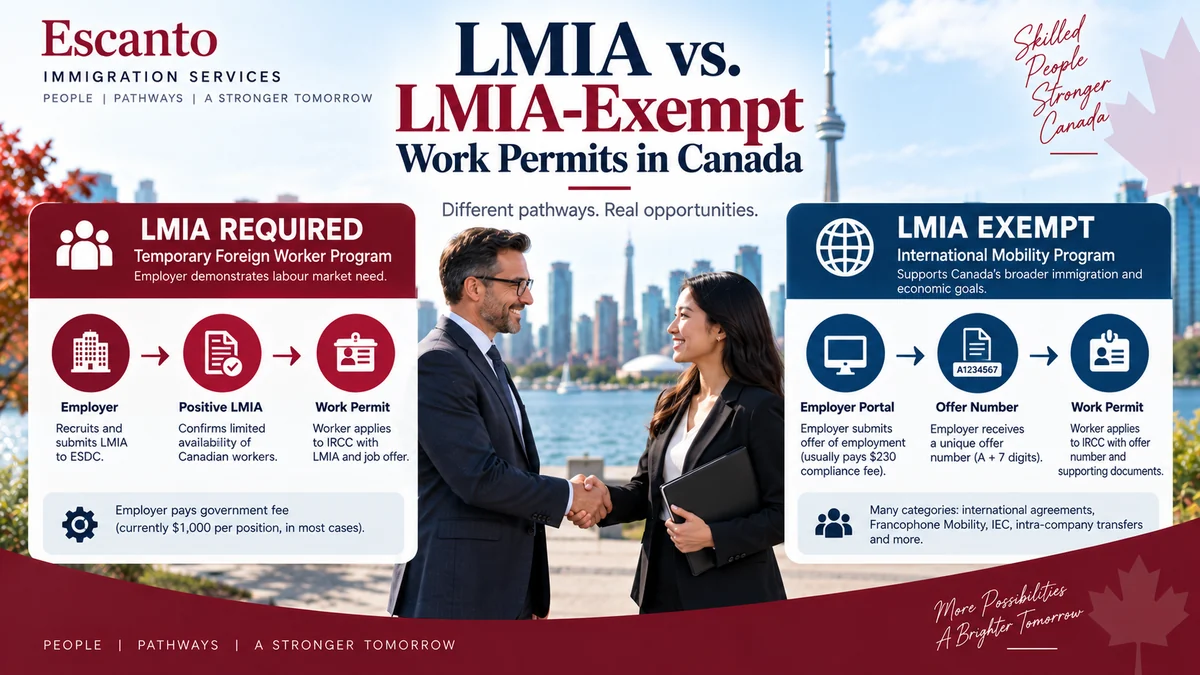
LMIA-required employment → Temporary Foreign Worker Program
and
LMIA-exempt employment → generally the International Mobility Program
Understanding which route applies is one of the first steps before preparing a Canadian work permit application.
What is an LMIA?
A Labour Market Impact Assessment is an assessment conducted by Employment and Social Development Canada / Service Canada.
For an LMIA-required position, the government considers whether hiring a temporary foreign worker is expected to have a positive, neutral or negative effect on the Canadian labour market.
The process can involve examining matters such as:
- whether the employer and job offer are legitimate;
- recruitment of Canadians and permanent residents;
- wages;
- working conditions;
- the occupation;
- the location of employment; and
- the employer’s compliance with program requirements.
A positive LMIA generally supports the employer’s request to hire a temporary foreign worker.
The foreign worker then uses the positive LMIA as part of the separate work permit application.
An LMIA is not a work permit
This distinction is fundamental.
An LMIA is normally obtained by the employer.
A work permit is normally applied for by the foreign worker.
A positive LMIA does not itself authorize the employee to begin working in Canada.
The usual sequence is:
Employer identifies need for worker → employer obtains positive LMIA → worker applies for work permit → IRCC decides work permit application
IRCC currently requires an LMIA-based employer-specific work permit applicant to provide supporting documentation such as the positive LMIA information and employment documentation.
The LMIA and the work permit are therefore related but legally distinct stages.
What is an LMIA-exempt work permit?
Some foreign workers can obtain employer-specific work permits without the employer first obtaining an LMIA.
These cases generally fall under Canada’s International Mobility Program (IMP).
IRCC states that the IMP allows Canadian employers to hire eligible temporary foreign workers without an LMIA.
Examples can include certain workers under:
- international trade agreements;
- Francophone Mobility;
- International Experience Canada categories;
- significant-benefit provisions;
- intra-company or international-agreement provisions;
- certain research or academic arrangements;
- specialized public policies; and
- other LMIA exemption codes.
Whether a worker qualifies depends on the exact exemption.
A job offer alone does not create an LMIA exemption.
Temporary Foreign Worker Program vs. International Mobility Program
The distinction is useful:
| Issue | Temporary Foreign Worker Program | International Mobility Program |
|---|---|---|
| LMIA | Generally required | Not required |
| Main government bodies | ESDC/Service Canada + IRCC | Primarily IRCC |
| Employer labour-market assessment | Yes | No LMIA |
| Employer-specific permit possible | Yes | Yes |
| Employer Portal | Generally not the LMIA process | Usually required for employer-specific IMP cases |
| Work permit still required? | Usually yes | Usually yes unless a separate work-permit exemption applies |
The fact that a case is LMIA-exempt does not necessarily mean it is work-permit-exempt.
Those are separate questions.
LMIA-exempt does not mean employer-free
This is another major misconception.
An LMIA-exempt employer-specific work permit still generally involves a Canadian employer.
In most International Mobility Program cases, the employer must:
- create an Employer Portal account;
- submit an offer of employment;
- identify the appropriate LMIA exemption;
- pay the applicable employer compliance fee, unless exempt;
- receive an offer-of-employment number; and
- give that number to the worker before the work permit application is submitted.
IRCC currently states that most IMP employers must submit the offer through the Employer Portal and pay a $230 employer compliance fee.
The worker then normally uses the Employer Portal-generated offer number when applying for the work permit.
What is the Employer Portal offer number?
For most LMIA-exempt employer-specific work permit applications, the employer submits the employment information through IRCC’s Employer Portal.
The portal generates an offer-of-employment number.
IRCC currently describes this number as beginning with:
A + seven digits
The worker normally needs that number when submitting the work permit application.
For example:
A1234567
The Employer Portal submission is therefore not simply an internal HR exercise.
It forms part of the immigration process.
Are there exceptions to the Employer Portal requirement?
Yes.
Some LMIA-exempt situations do not require the ordinary Employer Portal submission or employer compliance fee.
IRCC identifies certain employer and program exemptions, including some foreign missions, international organizations and other designated situations.
The correct procedure therefore depends on the actual LMIA exemption code.
An employer should not assume:
“LMIA-exempt means I always use the Employer Portal.”
Nor should the employer assume:
“LMIA-exempt means I have nothing to submit.”
Both can be incorrect.
What documents does an LMIA-based worker normally need?
For an employer-specific work permit based on a positive LMIA, IRCC currently requires documentation that can include:
- the positive LMIA and LMIA file number;
- employment contract;
- job offer letter;
- proof of relevant work experience;
- résumé;
- proof of qualifications or licensing where relevant; and
- for applicable Quebec employment, provincial documentation.
The exact requirements depend on the applicant and job.
The worker must still independently satisfy IRCC that they qualify for the work permit.
A positive LMIA does not guarantee work permit approval.
What documents does an LMIA-exempt worker normally need?
For an ordinary employer-specific LMIA-exempt application, IRCC currently expects the employer to provide:
- an employment contract; and
- the Employer Portal offer-of-employment number,
unless a specific exemption from the Employer Portal process applies.
The worker must also provide the other documentation relevant to:
- the claimed exemption;
- qualifications;
- immigration status;
- admissibility;
- job requirements; and
- the particular work permit category.
The important issue is not simply stating:
“This job is LMIA-exempt.”
The application must establish why the exemption legally applies.
Common LMIA-exempt categories
The International Mobility Program contains many exemption categories.
A few commonly encountered examples illustrate how different the rationales can be.
International trade agreements
Canada’s international trade agreements can provide work-permit options for certain eligible foreign nationals.
Depending on the agreement, this can include categories such as:
- professionals;
- intra-company transferees;
- traders;
- investors; or
- other specifically defined workers.
The applicant must satisfy the requirements of the relevant agreement.
Merely being a citizen of a country that has a trade agreement with Canada does not automatically create work authorization.
IRCC lists workers under free trade agreements among the categories that can qualify for employer-specific LMIA-exempt permits.
Francophone Mobility
Francophone Mobility is an LMIA-exempt pathway that can permit Canadian employers outside Quebec to hire eligible French-speaking or bilingual foreign workers, subject to the program requirements.
IRCC identifies Francophone Mobility among its LMIA-exempt employer-specific work permit categories.
The exemption does not mean that every French speaker automatically qualifies.
The worker and employment must satisfy the applicable criteria.
International Experience Canada
Certain International Experience Canada (IEC) categories can also involve LMIA exemptions.
For example:
- Young Professionals generally involves employer-specific work authorization; and
- International Co-op (Internship) can also be employer-specific.
IRCC identifies both as examples of LMIA-exempt employer-specific work permits.
The Working Holiday category generally operates differently because it normally provides an open work permit.
Eligibility depends on citizenship, age, participation rules and the relevant IEC arrangement.
Intra-company and international-agreement cases
Canadian immigration rules also contain LMIA exemptions for certain qualifying workers transferred within international businesses or admitted under international arrangements.
The exact corporate relationship, worker position, employment history and Canadian role can be important.
A multinational company’s decision to transfer an employee to Canada does not by itself prove that a particular LMIA exemption applies.
The immigration criteria still need to be established.
An open work permit is different again
An open work permit generally does not require an employer-specific LMIA because it is not tied to a particular employer in the ordinary way.
IRCC currently identifies examples of open work permit holders including:
- some permanent residence applicants with bridging open work permits;
- eligible post-graduation work permit holders;
- certain spouses or common-law partners;
- some family members of workers;
- and Working Holiday participants.
An employer hiring someone who already holds a valid open work permit generally does not submit an LMIA or Employer Portal offer merely because they hire that worker.
This should be distinguished from an employer-specific LMIA-exempt permit, where employer compliance obligations usually remain.
For a broader comparison, see Open vs. Employer-Specific Work Permits in Canada: What Is the Difference?
Does an LMIA prove that no Canadian applied for the job?
Not exactly.
An LMIA is a formal labour-market assessment.
Service Canada considers the applicable program requirements, which can include recruitment efforts and whether Canadians or permanent residents are available for the position.
A positive LMIA supports the conclusion that the requested hiring of a temporary foreign worker is justified under the applicable TFWP criteria.
It should not be simplified into a statement that literally no Canadian person applied.
The actual assessment is broader.
LMIA applications have different streams
There is not one universal LMIA application.
Employment and Social Development Canada currently identifies streams including:
- high-wage positions;
- low-wage positions;
- primary agriculture;
- Seasonal Agricultural Worker Program;
- Global Talent Stream;
- positions supporting permanent residence;
- caregiver positions; and
- foreign academic positions.
The applicable stream can change:
- recruitment obligations;
- wage requirements;
- permitted employment duration;
- processing;
- workforce caps; and
- supporting documentation.
Employers should therefore identify the appropriate stream before beginning recruitment or submitting the LMIA.
High-wage vs. low-wage LMIA applications
For many TFWP applications, the offered wage determines whether the position falls into the high-wage or low-wage stream.
As of July 17, 2026, the threshold is based on the provincial or territorial wage threshold published by ESDC.
For Ontario, the current threshold is $36.92 per hour.
That means, for an LMIA received under the applicable current rules:
- an offered wage at or above the Ontario threshold generally falls under the high-wage stream;
- an offered wage below it generally falls under the low-wage stream.
This threshold changes over time.
Employers should verify the current table immediately before preparing an LMIA.
The offered wage still needs to be appropriate
Simply increasing a wage to cross the high-wage threshold does not automatically make an LMIA approvable.
ESDC states that wages offered to temporary foreign workers should be consistent with the prevailing wage for the occupation and comparable employment.
It also warns that manipulating the offered wage simply to enter a preferred stream or avoid a program requirement can lead to a negative LMIA decision.
The threshold and the prevailing-wage requirement therefore perform different functions.
How much does an LMIA cost?
For many LMIA streams, the current processing fee is $1,000 for each position requested, subject to specific exemptions.
For example, ESDC currently confirms the $1,000 per-position fee for ordinary low-wage applications and states that the processing fee cannot be charged to or recovered from the temporary foreign worker.
The employer—not the worker—bears that fee where it applies.
Some streams and occupations have different fee rules or exemptions, so the applicable program should be checked.
An employer should not charge the worker for the LMIA fee
Where the LMIA processing fee applies, ESDC states that it cannot be paid by or recovered from the temporary foreign worker.
That is an important practical protection.
A worker should be cautious if an employer proposes to deduct the government’s LMIA processing fee from wages or requires the worker to reimburse that fee.
Other legitimate immigration or recruitment costs may have their own rules, so the particular charge should be identified before conclusions are drawn.
Does an LMIA guarantee a work permit?
No.
The LMIA decision and the work permit decision are separate.
Even with a positive LMIA, IRCC still determines whether the foreign national qualifies to receive the work permit.
The worker may need to establish matters such as:
- qualifications for the occupation;
- admissibility;
- genuine temporary residence;
- immigration status;
- medical requirements where relevant;
- licensing or certification;
- documentation; and
- compliance with the particular work permit requirements.
A positive LMIA is therefore an important supporting document—not a guarantee of admission or work authorization.
Does an LMIA exemption guarantee a work permit?
No.
The same principle applies.
Even if a job legitimately falls under an LMIA exemption, IRCC must still be satisfied that:
- the exemption actually applies;
- the employer completed the required process;
- the worker meets the requirements of the exemption;
- the worker meets the general work permit requirements; and
- the applicant is admissible to Canada.
LMIA-exempt does not mean “automatic work permit.”
Does an employer-specific work permit require a job offer?
Generally, yes.
IRCC states that a person applying for an employer-specific work permit needs a job offer from an employer who is not prohibited from hiring temporary foreign workers.
What happens next depends on the job:
LMIA required: employer obtains the positive LMIA.
LMIA exempt: employer follows the applicable International Mobility Program process.
LMIA-required does not mean “better” than LMIA-exempt
The two processes are not rankings of the quality of a job or worker.
They arise from different legal frameworks.
An LMIA may be required because Canada wants a labour-market assessment before the foreign worker is hired.
An LMIA exemption may exist because Canada has determined that another policy objective justifies permitting the employment without that labour-market test.
Examples may involve:
- international agreements;
- reciprocal employment;
- significant Canadian interests;
- Francophone immigration objectives;
- youth mobility; or
- other public-policy considerations.
The correct question is therefore not:
“Which one is better?”
It is:
“Which legal work authorization applies to this worker and this job?”
LMIA-exempt also does not mean “open work permit”
This distinction deserves emphasis.
An LMIA-exempt employer-specific permit can still restrict the worker to:
- one employer;
- one occupation;
- one location; or
- other conditions.
An open work permit normally provides greater employer flexibility.
Both may exist without an LMIA, but they are not the same permit.
IRCC recognizes employer-specific permits and open permits as the two main work-permit types.
What if an LMIA-based worker wants to change employers?
An employer-specific work permit belongs to the worker, but its employment conditions are tied to the approved employment.
Changing employers normally requires a new work permit supported by the appropriate documentation for the new employer.
That might mean:
- a new LMIA; or
- a new LMIA-exempt Employer Portal submission,
depending on the proposed new job.
Eligible workers already in Canada may also be able to request temporary authorization to begin the new employment while the new permit application is being processed.
For the full process, see Changing Employers on an Employer-Specific Work Permit in Canada.
What if the employer already has an LMIA?
The worker should confirm that the LMIA can actually support their work permit application.
Relevant issues can include:
- the LMIA validity period;
- employer;
- work location;
- occupation;
- number of positions;
- wage;
- whether the worker has been named where required; and
- whether the proposed application is consistent with the LMIA.
An employer saying “we have an LMIA” should therefore not be treated as the end of the immigration assessment.
How long does an LMIA take?
Processing time depends heavily on the LMIA stream and government workload.
ESDC updates LMIA processing-time information monthly.
For applications processed in August 2026, the published averages included:
| LMIA stream | Average processing time |
|---|---|
| Global Talent Stream | 10 business days |
| Seasonal Agricultural Worker Program | 6 business days |
| Agricultural stream | 25 business days |
| Low-wage stream | 82 business days |
| High-wage stream | 90 business days |
| Permanent resident stream | 156 business days |
These are historical averages, not guaranteed service standards for a particular application.
Because processing times change, employers should check the current figures rather than relying on an old estimate.
LMIA processing and work permit processing are separate timelines
A worker and employer should also remember that an LMIA case can involve two separate processing periods.
First:
Service Canada processes the LMIA.
Then:
IRCC processes the foreign worker’s work permit application.
Planning only for the LMIA timeline can therefore underestimate how long the entire process may take.
LMIA-exempt cases generally avoid the LMIA stage, but still require the relevant Employer Portal and work permit processes.
Can someone apply for an employer-specific permit at the border?
Some foreign nationals may be eligible to apply for a work permit at a Canadian port of entry, but this is not available to everyone.
IRCC currently requires eligible port-of-entry applicants for employer-specific permits to have either:
- a positive LMIA for an LMIA-required job; or
- an offer-of-employment number for an LMIA-exempt job.
Visa-required travellers generally cannot use the ordinary port-of-entry work permit process.
Workers should verify eligibility before travelling rather than assuming that a work permit can simply be requested at the airport or border.
Work-permit exemptions are another separate category
Some activities can be performed in Canada without a work permit at all.
That should not be confused with an LMIA exemption.
The three concepts are:
LMIA required + work permit required
LMIA exempt + work permit required
work permit exempt
The International Mobility Workers Unit can, in certain eligible circumstances, provide employers with an opinion about whether an LMIA or work-permit exemption applies.
This distinction is particularly relevant where the proposed activity may fall within a specialized exemption.
Business visitors provide a good example
Some foreign nationals travelling to Canada for qualifying international business activities may enter as business visitors without obtaining a work permit.
That is different from an LMIA-exempt work permit.
If the activities cross into work in the Canadian labour market, a work permit may be required.
For the distinction, see Business Visitor or Work Permit? Understanding the Difference in Canada.
Common LMIA and LMIA-exempt misconceptions
“Every foreign worker needs an LMIA.”
Incorrect.
Canada has many LMIA-exempt work permit categories under the International Mobility Program.
“LMIA-exempt means no work permit is required.”
Incorrect.
Many LMIA-exempt workers still require an employer-specific work permit.
“My employer submitted an Employer Portal offer, so my work permit is approved.”
No.
The Employer Portal submission is only one part of the LMIA-exempt process.
IRCC must still decide the worker’s application.
“My employer received a positive LMIA, so I can begin working.”
Not normally.
A positive LMIA is not itself work authorization.
The worker generally needs the applicable work permit.
“An LMIA and Employer Portal offer are interchangeable.”
No.
They represent different employer processes.
LMIA-required employment generally proceeds through the Temporary Foreign Worker Program.
Employer-specific LMIA-exempt employment generally proceeds through the International Mobility Program.
“All LMIA-exempt permits are open permits.”
No.
Many LMIA-exempt permits are employer-specific.
“The employer can make the worker pay the government’s LMIA processing fee.”
For LMIA streams where the processing fee applies, ESDC states that the fee cannot be paid by or recovered from the temporary foreign worker.
“Any job offer can qualify for an LMIA exemption.”
No.
An actual statutory, regulatory, treaty, program or public-policy exemption must apply.
Practical checklist for an employer
Before offering employment to a foreign national, determine:
- Does the person already have valid open work authorization?
- Is the proposed activity work for immigration purposes?
- Does a work-permit exemption apply?
- If a permit is required, is it employer-specific or open?
- Does the job require an LMIA?
- If LMIA-required, which TFWP stream applies?
- What wage and recruitment requirements apply?
- Is the employer eligible to use the program?
- Has the correct LMIA application been submitted?
- If LMIA-exempt, what exemption code applies?
- Does the Employer Portal process apply?
- Has the employer compliance fee been paid where required?
- Has the worker received the correct LMIA or offer-of-employment information?
- Does the worker meet the job’s educational, licensing or experience requirements?
- When can the worker legally begin employment?
Practical checklist for a foreign worker
Before relying on a Canadian job offer, ask:
- What type of work permit will I need?
- Is the permit open or employer-specific?
- Does the employer say the job is LMIA-required or LMIA-exempt?
- If LMIA-required, has a positive LMIA actually been issued?
- Does the LMIA correspond to my proposed position?
- If LMIA-exempt, what specific exemption applies?
- Has the employer submitted the Employer Portal offer where required?
- Have I received the offer-of-employment number?
- Do I have the employment contract?
- Do I satisfy the qualifications for the job?
- Do I need a medical examination?
- Do I require a visa or eTA to travel?
- Am I eligible to apply from inside Canada, outside Canada or at a port of entry?
- If I am already working in Canada, will changing employers require a new permit?
- Have I received actual work authorization before beginning employment?
Choosing the correct process matters
The difference between LMIA-required and LMIA-exempt employment is not merely administrative.
Using the wrong process can result in:
- an employer submitting an unnecessary LMIA;
- an Employer Portal submission under the wrong exemption;
- a work permit refusal;
- delays;
- employment beginning without proper authorization; or
- compliance problems for the employer and worker.
The analysis should begin with the worker, employer and proposed Canadian job—and then identify the immigration category that actually applies.
For a broader explanation of permit types, see Open vs. Employer-Specific Work Permits in Canada: What Is the Difference?
Workers already in Canada who want to move to another employer can review Changing Employers on an Employer-Specific Work Permit in Canada.
Spouses who may qualify independently for open work authorization can review Spousal Open Work Permits in Canada: Who May Qualify in 2026?
Escanto Immigration Services assists with Work in Canada matters, including employer-specific permits, LMIA-exempt categories, employer changes and temporary worker immigration planning.
For advice based on the proposed job, employer, work permit category and immigration history, book a consultation.
Explore additional Canadian immigration guidance in Escanto Insights.
Official sources
- IRCC — Employer-specific work permits
- IRCC — International Mobility Program: who can be hired without an LMIA
- IRCC — Employer Portal
- IRCC — How employers hire through the International Mobility Program
- ESDC — Temporary Foreign Worker Program / LMIA streams
- ESDC — 2026 high-wage and low-wage thresholds
- ESDC — Current LMIA processing times