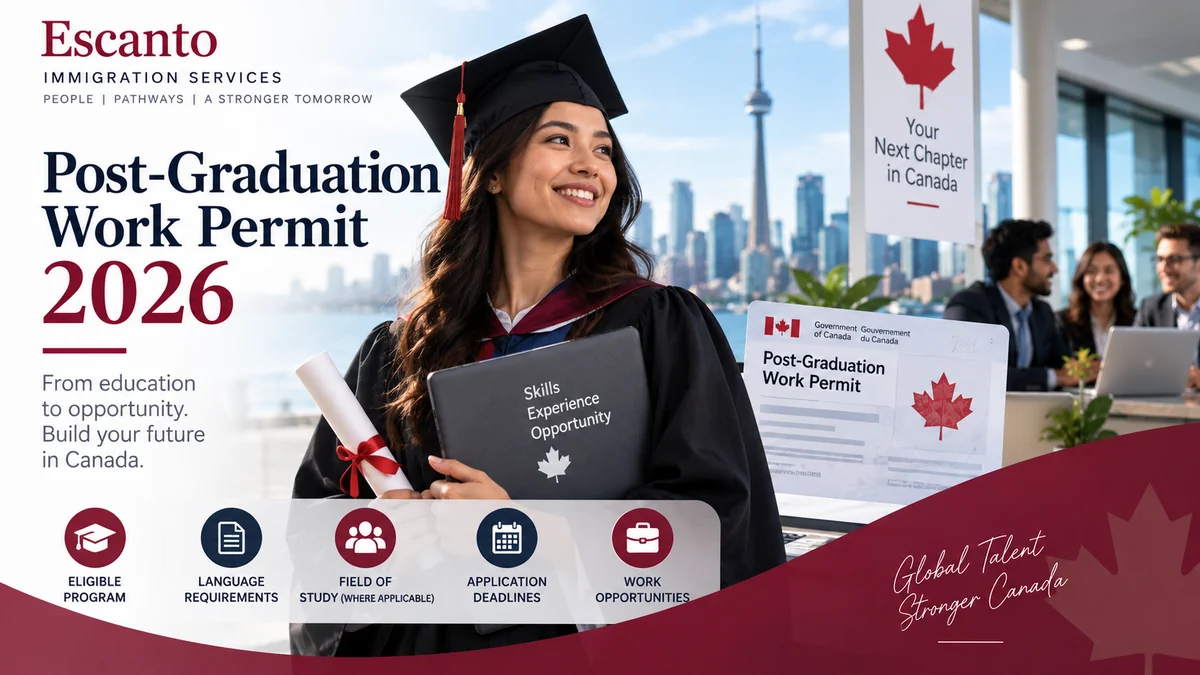
What is a Post-Graduation Work Permit?
A Post-Graduation Work Permit (PGWP) is an open work permit available to some international students after completing an eligible Canadian program of study.
Unlike an employer-specific work permit, a PGWP is generally not tied to a particular employer or job offer. It can allow an eligible graduate to gain Canadian work experience after completing their studies.
However, graduating from a Canadian school does not automatically make someone eligible for a PGWP.
The applicant must satisfy requirements relating to:
- the educational institution;
- the specific program of study;
- program length;
- full-time study;
- language ability;
- field of study, where applicable;
- where and how the program was completed;
- application timing; and
- immigration status.
For students planning their education in Canada, PGWP eligibility should therefore be investigated before choosing a program, not only after graduation.
A DLI does not automatically mean the program is PGWP eligible
International students generally need to study at a Designated Learning Institution (DLI) to obtain a study permit.
But there is an important distinction:
DLI status and PGWP eligibility are not the same thing.
IRCC expressly states that graduating from a DLI does not automatically make a graduate eligible for a PGWP. Students should verify that the specific program is PGWP eligible.
This is particularly important where:
- a school offers both eligible and ineligible programs;
- a program is delivered through another institution;
- the student studies through a public-private curriculum licensing arrangement; or
- the program does not satisfy the current PGWP rules.
General PGWP eligibility requirements
IRCC currently states that an applicant generally needs to have:
- completed a PGWP-eligible program at an eligible DLI;
- completed a program of at least 8 months, or at least 900 hours for certain Quebec programs;
- maintained full-time student status during each semester of the program, subject to limited exceptions such as the final semester;
- applied for the PGWP within 180 days of receiving confirmation that the program was completed; and
- held a valid study permit at some point during that 180-day period.
There are special rules and exceptions for certain circumstances, so these general requirements should not be treated as a complete eligibility assessment.
The November 1, 2024 changes remain important in 2026
PGWP eligibility changed substantially for applications made on or after November 1, 2024.
Two of the most significant changes are:
- most PGWP applicants must now prove English or French language ability; and
- graduates of certain programs must satisfy a field-of-study requirement.
The applicable requirements depend partly on:
- the type of credential;
- the type of institution or program; and
- when the student submitted the study permit application.
That means two students graduating from apparently similar programs can potentially face different PGWP requirements because of their educational level or application history.
Not sure whether your Canadian study program qualifies for a Post-Graduation Work Permit?
Graduating from a designated learning institution does not automatically establish PGWP eligibility. Your program, credential, study permit application date, language results and, where applicable, CIP code can affect your eligibility. Escanto can help assess your circumstances before you proceed with your application.
Book a PGWP Consultation →Language requirements for PGWP applications
Most applicants submitting a PGWP application on or after November 1, 2024 must provide approved English or French language results.
IRCC uses:
- Canadian Language Benchmarks (CLB) for English; and
- Niveaux de compétence linguistique canadiens (NCLC) for French.
The required level depends on the type of program completed.
Bachelor’s, master’s and doctoral graduates
Graduates with a:
- bachelor’s degree;
- master’s degree; or
- doctoral degree
must generally demonstrate at least:
CLB 7 in English or NCLC 7 in French in all four language abilities.
The four abilities are:
- reading;
- writing;
- listening; and
- speaking.
Other university programs
Graduates of other university programs must also generally demonstrate:
CLB 7 or NCLC 7 in all four language abilities.
However, unlike bachelor’s, master’s and doctoral graduates, these students may also face a field-of-study requirement depending on when they applied for their study permit.
College, polytechnic and other non-university programs
Graduates of other college, polytechnic or non-university programs generally require at least:
CLB 5 or NCLC 5 in all four language abilities.
These graduates may also need to satisfy the field-of-study requirement.
Flight-school graduates
Graduates of qualifying PGWP-eligible flight schools are treated differently.
IRCC currently exempts eligible flight-school graduates from the new language and field-of-study requirements, although they must satisfy the applicable flight-training eligibility conditions.
Which graduates need an eligible field of study?
The field-of-study requirement does not apply to everyone.
IRCC currently states that the requirement does not apply if, among other exceptions:
- the PGWP application was submitted before November 1, 2024;
- the person graduated from a PGWP-eligible flight school;
- the person graduated with a bachelor’s, master’s or doctoral degree; or
- the person submitted their study permit application before November 1, 2024.
This distinction is critical.
Bachelor’s, master’s and doctoral degrees
Graduates of bachelor’s, master’s and doctoral programs currently do not have to satisfy a field-of-study requirement for PGWP eligibility.
They still generally need to satisfy the applicable language requirement and the other PGWP requirements.
Other university programs
For other university programs, a field-of-study requirement generally applies where the student submitted the study permit application on or after November 1, 2024.
College, polytechnic and non-university programs
The same general principle applies to college, polytechnic and other non-university programs.
If the study permit application was submitted on or after November 1, 2024, the program must generally fall within an eligible field of study.
What is a CIP code?
IRCC uses Classification of Instructional Programs (CIP) codes to determine whether a program satisfies the PGWP field-of-study requirement.
A CIP code is a six-digit classification used to identify a particular field of education.
Students can obtain or verify the applicable CIP code through:
- their DLI;
- the institution’s website; or
- Statistics Canada’s CIP classification system.
The actual CIP classification matters more than the marketing name of the program.
For example, two programs may have similar titles but different CIP codes and therefore potentially different PGWP treatment.
Eligible PGWP fields of study in 2026
The current eligible CIP codes are organized around fields connected to occupations experiencing longer-term labour shortages.
The principal field groups include:
- agriculture and agri-food;
- education;
- healthcare and social services;
- science, technology, engineering and mathematics (STEM);
- trades; and
- transport.
There are many individual CIP codes within these categories.
A student should therefore verify the specific six-digit CIP code, rather than assuming that a program qualifies simply because it appears generally related to healthcare, technology, education or another broad sector.
The field-of-study list is frozen for 2026
This is particularly important for students planning or completing programs in 2026.
IRCC currently states:
For 2026, it will not add or remove eligible PGWP fields of study.
This provides more stability than students experienced in 2025, when IRCC made changes to the eligible CIP list.
In June 2025, IRCC initially removed a number of fields and added others. On July 4, 2025, some of the removed fields were restored. IRCC reported that the resulting list contained 920 eligible fields of study.
For 2026, however, the eligible field list has been frozen.
That does not eliminate the need to check the actual CIP code.
It means the current list is not expected to have fields added or removed during 2026.
The study-permit application date can protect earlier eligibility
Field-of-study eligibility is more nuanced than checking whether a CIP code appears on today’s list.
IRCC explains that a program can sometimes remain eligible based on when the student submitted the study permit application, even if the treatment of that CIP code later changed.
This became particularly relevant following the 2025 field-of-study changes.
A proper PGWP assessment may therefore need to consider:
- the program’s CIP code;
- the student’s study-permit application date;
- whether that CIP code was eligible at the relevant time; and
- the current PGWP eligibility rules.
Students should not assume that the current online list alone tells the full story in every historical case.
How long can a PGWP be issued for?
The maximum length of the PGWP depends primarily on:
- the type of program;
- the length of the program;
- whether multiple eligible programs were completed; and
- the applicant’s passport validity.
Programs between 8 months and less than 2 years
For an eligible program of at least 8 months but less than 2 years, IRCC may issue a PGWP for up to approximately the same length as the study program.
For example, a 9-month eligible program could result in a PGWP valid for up to approximately 9 months.
Programs of 2 years or longer
For an eligible program lasting at least 2 years, IRCC may issue a PGWP valid for up to 3 years.
Master’s programs
A special rule applies to qualifying master’s degree programs.
For eligible master’s programs completed on or after February 15, 2024, a graduate may qualify for a 3-year PGWP even if the master’s program was less than 2 years, provided the program was at least 8 months long and the applicant satisfies the other eligibility requirements.
This special treatment does not automatically extend to ordinary diploma or certificate programs of the same duration.
Combining more than one study program
A graduate who completed more than one eligible program may sometimes be able to combine the program lengths for PGWP purposes.
IRCC currently requires each program being combined to:
- be PGWP eligible; and
- generally be at least 8 months long, or 900 hours for qualifying Quebec credentials.
Where the programs have different language requirements, IRCC states that the applicant must satisfy the higher applicable language requirement.
The facts of the individual study history should therefore be reviewed before assuming that two credentials can automatically be combined.
Passport validity can shorten the PGWP
Even if a graduate otherwise qualifies for a longer PGWP, the permit normally cannot be issued beyond the applicant’s passport expiry date.
IRCC advises applicants to ensure that the passport is valid for the full period of PGWP eligibility before applying.
If a PGWP is shortened specifically because the passport expired earlier, IRCC may permit an application to extend the PGWP after the applicant obtains a new passport.
This is a limited situation and should not be confused with a general right to renew a PGWP.
A PGWP is normally issued only once
A person is generally not eligible for another PGWP if they previously received a PGWP after completing an earlier program.
This makes program selection particularly important.
Using PGWP eligibility after one program can have long-term consequences if the person later returns to school and assumes another PGWP will automatically be available.
Full-time study remains important
Applicants generally must have maintained full-time student status in Canada during each semester of the study program.
IRCC permits an exception where the student studies part-time during the final semester.
Other circumstances, such as authorized leave, may require a more detailed assessment.
An unauthorized break from studies can create PGWP eligibility problems.
Authorized leave
IRCC recognizes circumstances in which an authorized leave of up to 150 days may still be compatible with study-permit conditions.
Where relevant, the applicant should maintain documentation confirming that the DLI authorized the leave.
The existence of a leave should therefore be reviewed before submitting the PGWP application rather than assuming it has no immigration consequence.
Distance learning can affect PGWP eligibility and length
The pandemic-era distance-learning policies have largely ended.
For students whose relevant lock-in date is on or after September 1, 2024, IRCC currently requires at least 50% of the program to be completed in class in Canada.
Time spent studying outside Canada is deducted from the potential length of the PGWP.
IRCC also states that completing more than 50% of a program through distance learning can make the applicant ineligible, subject to the historical COVID-related exceptions.
Students undertaking online or hybrid programs should therefore determine how their delivery format affects PGWP eligibility before assuming that remote study will be treated the same as in-person study.
Public-private curriculum licensing programs require particular caution
Some Canadian programs are delivered by private colleges on behalf of public institutions under curriculum licensing arrangements.
These are sometimes referred to as public-private partnership programs or P3 programs.
IRCC states that these programs are generally not PGWP eligible, although limited transitional exceptions exist for students who began certain programs before specified dates.
For same-province arrangements, students who began such a program after May 15, 2024 are generally not PGWP eligible under this exception.
For certain interprovincial arrangements, the relevant transitional deadline was earlier.
This is another reason why checking only the name of the public institution is insufficient.
When should a graduate apply for the PGWP?
An eligible graduate generally has 180 days after receiving confirmation of program completion to apply for the PGWP.
The applicant does not necessarily need to wait for the physical graduation ceremony or printed diploma.
IRCC accepts evidence such as:
- an official completion letter;
- an official transcript; or
- an eligible copy of the transcript from the school’s website.
Study-permit validity still matters
The study permit must have been valid at some point during the 180 days following completion of the program.
A study permit can also expire 90 days after the student completes the studies, even where a later expiry date is printed on the permit.
Students should therefore pay close attention to their status after completing their program.
What if the study permit expires before the PGWP application?
The answer depends on the circumstances.
If the student remains in Canada and the study permit will expire before the required completion documents are available, IRCC identifies options such as:
- applying to change status to visitor before the study permit expires; or
- leaving Canada and later applying for the PGWP from outside Canada.
Where status has already expired, an eligible applicant may in some circumstances apply for the PGWP and restore student status within the applicable restoration period.
IRCC currently states that this generally must occur within 90 days after losing status.
Status issues can affect both the PGWP application and the person’s ability to remain or work in Canada, so timing should be addressed carefully.
Can a PGWP be applied for at the border?
No.
Since June 21, 2024, PGWP applications can no longer be made at a Canadian port of entry.
Eligible applicants can apply from inside Canada or from another country, depending on their circumstances, but should follow IRCC’s current application procedure.
Can someone work while waiting for a PGWP?
Some graduates may be authorized to work while their PGWP application is being processed, provided they meet the applicable requirements.
Whether this authorization applies depends on factors such as:
- having submitted the PGWP application while eligible;
- the person’s status when applying; and
- whether they met the conditions permitting off-campus work during their studies.
This should be assessed based on the graduate’s actual immigration history rather than assuming every PGWP applicant can automatically begin or continue working.
Language test results must be submitted even if the checklist says “optional”
This is a practical issue worth emphasizing.
IRCC states that the online PGWP document checklist may display proof of language results as an optional document.
However, where the language requirement applies, the applicant must still submit qualifying language results.
Failing to provide required language evidence can result in refusal.
The label appearing in an online upload field should therefore not be treated as overriding the substantive PGWP eligibility requirements.
Proof of field of study may also require special uploading
Where the field-of-study requirement applies, the applicant must provide evidence establishing that the program corresponds to an eligible CIP code.
IRCC currently instructs applicants to upload this proof through the Client Information section because of limitations in the online application system.
This is another example of why completing only the obvious document slots in an online checklist may not be sufficient.
Common PGWP eligibility mistakes
Assuming every Canadian college program qualifies
It does not.
The school and the specific program must satisfy PGWP requirements.
Checking only whether the school is a DLI
DLI status alone does not establish PGWP eligibility.
Ignoring the CIP code
For applicants subject to the field-of-study requirement, the program’s six-digit CIP code is critical.
Using the wrong language threshold
The threshold is generally:
- CLB/NCLC 7 for university-level programs; and
- CLB/NCLC 5 for college, polytechnic and other non-university programs,
subject to the specific program rules.
Assuming a bachelor’s degree needs an eligible CIP code
It currently does not.
Bachelor’s, master’s and doctoral graduates are exempt from the field-of-study requirement.
Waiting too long after graduation
The general PGWP application window is 180 days after confirmation of program completion.
Allowing immigration status to expire without a plan
The PGWP application deadline and the applicant’s temporary-resident status are separate issues.
Assuming online study has no effect
For newer programs, the amount of in-person study in Canada can directly affect eligibility and permit duration.
Assuming the PGWP can simply be renewed
A PGWP is generally issued only once, and ordinary renewal is not available merely because the holder wants additional time.
A practical PGWP eligibility checklist for 2026
Before applying, confirm:
- Is the school a DLI?
- Is the specific program PGWP eligible?
- Was the program at least 8 months long, or does an applicable Quebec rule apply?
- Did you maintain the required full-time student status?
- Was any leave from studies properly authorized?
- When did you submit your study permit application?
- Are you subject to the field-of-study requirement?
- What is your program’s six-digit CIP code?
- Is that CIP code eligible under the rules applicable to you?
- What language level applies to your credential?
- Do your English or French test results satisfy that level in all four abilities?
- Did you complete the required portion of the program in person in Canada?
- Was the program delivered through a curriculum licensing arrangement?
- When did the school confirm that you completed the program?
- Are you still within the 180-day PGWP application period?
- What is your current immigration status?
- Is your passport valid for the full period of PGWP eligibility?
- Have you already received a PGWP in the past?
- Have you included the required graduation, language and CIP documentation?
- If you intend to work while the application is processed, are you actually authorized to do so?
PGWP eligibility should be considered before choosing a study program
For prospective international students, one of the most important lessons from the current rules is that PGWP planning should begin before enrolling in a program.
A study permit and a PGWP are separate immigration processes.
Admission to a school does not guarantee:
- study-permit approval;
- PGWP eligibility;
- a particular PGWP duration;
- employment after graduation; or
- permanent residence.
Students considering Canadian education should therefore evaluate both the academic program and its immigration implications before making substantial financial commitments.
For information about the earlier stage of the process, see Applying for a Canadian Study Permit: What Applicants Should Prepare.
Graduates comparing employment authorization can also review Open vs. Employer-Specific Work Permits in Canada: What Is the Difference?
Canadian work experience obtained through a PGWP may later be relevant to economic immigration programs, but permanent residence remains a separate process. See How Express Entry Works in Canada: Eligibility, CRS and the Application Process for an overview.
Escanto Immigration Services assists students and graduates with Study in Canada matters, including study-permit planning, PGWP eligibility assessment and post-graduation immigration considerations.
For advice based on your school, program, CIP code, study history and immigration status, book a consultation.
Explore more Canadian immigration guidance in Escanto Insights.