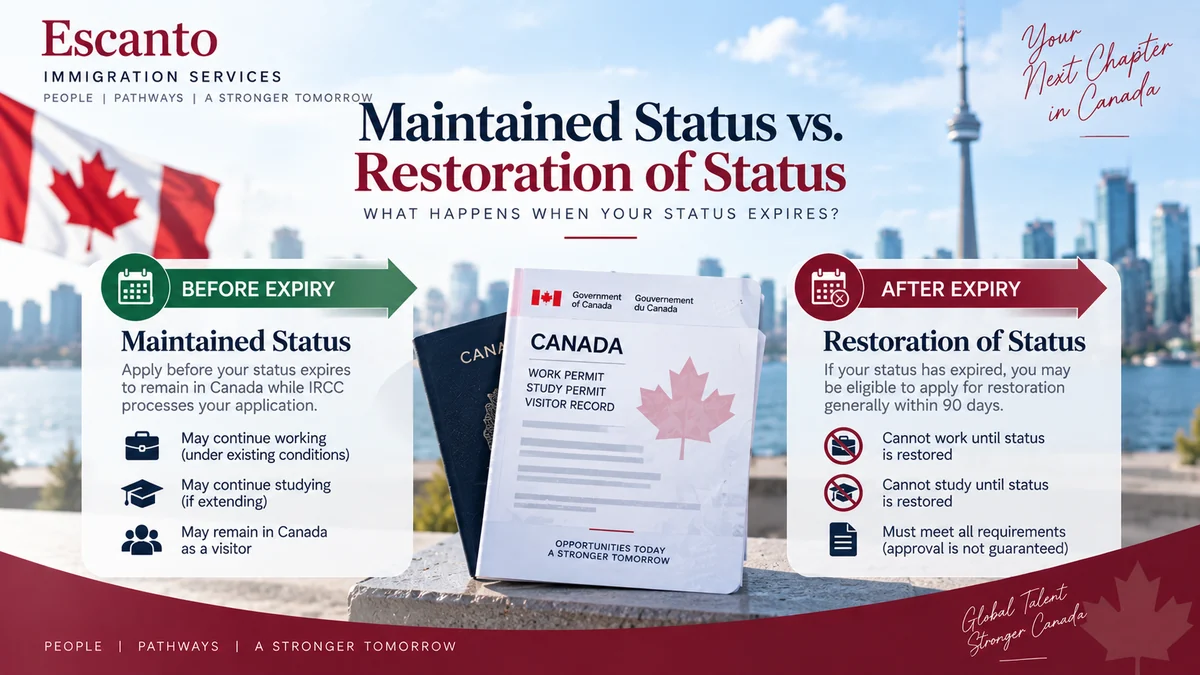
Temporary residents in Canada need to pay close attention to the expiry dates and conditions attached to their immigration status.
Two terms frequently arise when a visitor, worker or student is approaching—or has passed—the expiry of their authorized stay:
maintained status and restoration of status.
They describe fundamentally different situations.
In simplified terms:
- Maintained status can arise when an eligible temporary resident submits the appropriate extension or change application before their current status expires.
- Restoration may be available after the person has already lost temporary resident status, generally if the restoration application is submitted within the applicable deadline and the person remains eligible.
The distinction matters because it can determine whether a person may legally remain in Canada and whether they may continue working or studying while IRCC processes the application.
What is maintained status?
Maintained status allows an eligible temporary resident to remain in Canada while IRCC decides an application to extend or change their temporary status, provided the qualifying application was submitted before the existing period of authorized stay expired.
For example, IRCC confirms that a worker who applies to extend or change the conditions of a work permit before it expires may legally remain in Canada while the application is being processed.
The same general principle applies to eligible students extending their study permits and visitors who apply to extend their stay before their authorized period ends.
The critical point is timing:
The application must generally be submitted before the existing status expires.
What is restoration of status?
Restoration applies after temporary resident status has already been lost.
Under the ordinary rules, a visitor, worker or student may be able to apply to restore temporary resident status within 90 days of losing it, provided the person continues to meet the applicable requirements and the circumstances fall within the restoration provisions.
Restoration is not automatic.
IRCC assesses the application, and there is no guarantee that restoration will be approved.
This produces the central distinction:
Maintained status preserves status while a timely application is pending.
Restoration asks IRCC to restore status after it has already been lost.
Has your Canadian immigration status expired, or are you unsure whether you have maintained status?
Your immigration options may depend on when your previous authorization expired, which applications you submitted, and whether you remain eligible for restoration. Restoration deadlines can be time-sensitive, and submitting an application does not automatically authorize you to work or study. Escanto can assess your circumstances and explain the options that may be available.
Book an Immigration Status Consultation →A simple example
Consider a worker whose work permit expires on October 31.
Scenario 1 — application submitted October 25
If the worker submits an eligible work-permit extension application before October 31, the person may have maintained status after the existing permit expires while IRCC processes the application.
Depending on the application, the worker may also be authorized to continue working under the applicable conditions.
Scenario 2 — application submitted November 10
If the work permit expired on October 31 and no qualifying application was submitted beforehand, the worker generally lost temporary resident status.
Submitting an application on November 10 does not retroactively create maintained status.
The person may instead need to apply for restoration, if eligible, and must generally stop working until status and work authorization are restored.
The difference of a few days can therefore have significant immigration and employment consequences.
Maintained status for workers
A worker who submits an eligible application to extend or change a work permit before the current permit expires may remain in Canada while IRCC processes the application.
But whether the worker can continue working depends on what application was submitted.
Extending a work permit
If the worker applied to extend a work permit before it expired, IRCC states that the person may generally continue working without a new permit while the application is pending, provided the applicable conditions are satisfied and the person remains in Canada.
For an employer-specific work permit, the worker generally has to continue complying with the conditions of the original permit while relying on ordinary maintained-status work authorization.
That can include the same:
- employer;
- occupation; and
- work location.
IRCC describes this as continuing to work under the conditions of the original work permit.
Applying to become a visitor
Suppose a worker does not intend to continue working and applies to change status from worker to visitor before the work permit expires.
The person may have maintained temporary resident status while the visitor application is processed.
However, once the work permit itself expires, the person must stop working.
IRCC specifically states that a worker who applies for a visitor record may continue working only until the existing work permit expires—not throughout the visitor application processing period.
So:
maintained status does not necessarily mean maintained work authorization.
Maintained status for students
A student who applies to extend or change the conditions of a study permit before it expires may remain in Canada while IRCC processes the application.
Where the person applied to extend the study permit and continues to meet the applicable requirements, IRCC states that the student can generally continue studying while waiting for the decision.
Again, the type of application matters.
If a student instead applies for a different type of permit, such as a work permit, the person should not assume that maintained status automatically authorizes continued study.
IRCC states that a student who applied for a work permit instead of extending the study permit cannot simply continue studying while waiting for that different application to be decided.
Maintained status for visitors
Visitors can also benefit from maintained status.
If a visitor applies to extend the authorized stay through a visitor record before the existing period of stay expires, IRCC states that the person may legally remain in Canada until a decision is made.
A visitor record is a document that extends or changes a person’s authorized temporary stay in Canada.
It is not a visa, and it does not itself guarantee re-entry to Canada after international travel.
A work permit, study permit and visa are not the same thing
A common source of confusion is assuming that all Canadian immigration documents perform the same function.
They do not.
A:
- work permit authorizes work subject to its conditions;
- study permit authorizes study subject to its conditions;
- visitor record establishes authorized temporary stay as a visitor;
- temporary resident visa (TRV) or eTA may be required for travel and entry to Canada.
For example, IRCC expressly states that a work permit is not a travel document and does not itself guarantee re-entry to Canada.
That becomes especially important when someone on maintained status considers travelling outside Canada.
Travelling while on maintained status can change what you are allowed to do
Leaving Canada while an extension application is pending requires caution.
A person may be able to leave Canada and later seek re-entry if they have the required travel documents and remain admissible.
But re-entry does not necessarily mean the person can immediately resume the activity they were previously authorized to perform.
Workers
IRCC currently states that if a worker leaves Canada while a work-permit renewal remains pending and later returns before the application is approved, the person may be admitted as a visitor but generally cannot resume working until the work permit renewal is approved.
Students
IRCC similarly states that a student whose study-permit extension remains pending may potentially be allowed to re-enter Canada, but cannot resume studies until the extension is approved.
Special rules can apply in particular situations—for example certain PGWP applicants—so travel consequences should be reviewed according to the actual application.
The practical lesson is:
Do not assume maintained status will function exactly the same way after leaving Canada and returning.
What happens when temporary status is lost?
A person may lose temporary resident status where, for example:
- the authorized stay expires before an extension application is submitted;
- the person violates conditions of the permit; or
- the person works or studies contrary to restrictions imposed on their temporary status.
IRCC’s restoration guidance recognizes several types of non-compliance that may potentially be addressed through restoration, including certain situations involving:
- overstaying;
- changing employers or employment conditions without first obtaining the required authorization; or
- changing specified study conditions without obtaining the required authorization.
Restoration eligibility still depends on the full circumstances.
The normal restoration deadline is 90 days
Under the ordinary restoration rules, an eligible person generally has 90 days from the date temporary resident status was lost to submit the restoration application.
The deadline should be treated carefully.
For online restoration applications, IRCC’s current worker guidance states that it must receive the application before midnight UTC within the 90-day restoration period.
That can matter for someone submitting an application near the deadline from a Canadian time zone.
Waiting until the final evening locally can create unnecessary risk because IRCC’s online system uses Coordinated Universal Time (UTC) for this purpose.
Restoration does not mean you can keep working
This is one of the most important distinctions.
If a worker loses temporary resident status, IRCC states that the worker must stop working.
After applying for restoration and a new work permit, the person may remain in Canada while IRCC decides the application, but normally cannot resume work until:
- status has been restored; and
- the new work permit has been issued.
Submitting the restoration application does not recreate the previous work authorization.
Restoration does not mean you can keep studying
The same principle applies to students.
If a study permit expires before the student submits the necessary extension application and status is lost, the student must stop studying.
IRCC states that a student who submits a restoration application may remain in Canada while it is processed, but cannot resume studies until status is restored and the new study permit is issued.
So:
restoration pending ≠ maintained student status
and
restoration pending ≠ authorization to continue studying.
Applying for restoration does not restore status immediately
A restoration application is a request for IRCC to restore status.
The person is not considered to have maintained status simply because the restoration application has been submitted.
For workers and students, IRCC allows the applicant to remain in Canada while it decides the restoration application, but the applicant normally cannot work or study during that period.
There is also no guarantee that restoration will be approved.
Can a worker restore status as a visitor instead?
Potentially.
If someone is no longer eligible for—or no longer needs—a work or study permit but remains within the restoration period, IRCC permits an eligible person to seek restoration of temporary resident status as a visitor instead.
That does not preserve employment authorization.
If restored as a visitor, the individual is a visitor unless separately authorized to work.
Can someone change immigration categories during restoration?
This area requires care.
IRCC explains that where a work permit and worker status have already expired, a person who wishes to change to another type of permit may first need restoration of the prior status or authorization as part of the process.
For example, IRCC gives the example of someone whose work permit expired and who now wants a study permit.
Depending on eligibility, the person may need to:
- restore worker status and work authorization; and
- apply for the study permit.
IRCC then considers restoration before processing the new permit request.
The appropriate filing strategy depends on which status expired and what new authorization is being sought.
PGWP applicants have a specific restoration rule
Graduates need to be especially careful because the 180-day PGWP application deadline and the 90-day restoration period are not the same thing.
IRCC currently states that where a student’s study permit expires before the PGWP application is submitted, an otherwise eligible graduate may have up to 90 days after the study permit expires to apply for the PGWP and restore student status.
The applicant cannot work while waiting if the study permit had already expired when the PGWP application was submitted.
This is another reason to address immigration status before the study permit expires whenever possible.
For the broader PGWP requirements, see Post-Graduation Work Permit Eligibility in 2026: Language, Field of Study and Program Requirements.
Each family member has their own status
Immigration status is individual.
If a spouse, common-law partner or dependent child also loses status, the principal applicant’s restoration application does not automatically restore the family member.
IRCC states that each family member who needs restoration must submit the appropriate request and pay the applicable restoration fee.
Families should therefore check the expiry date and conditions of every person’s immigration document.
What if more than 90 days have passed?
Under the ordinary restoration rules, a person who misses the applicable 90-day restoration period generally cannot use the regular in-Canada restoration process.
Depending on the circumstances, the individual may need to leave Canada and pursue the appropriate immigration authorization from outside Canada.
However, temporary public policies can occasionally create exceptions.
Special 2026–2028 natural-disaster measure
IRCC currently has a special measure for certain temporary residents directly affected by qualifying natural disasters in Canada between April 1, 2026 and November 30, 2028.
Eligible affected visitors, workers and students may have up to six months to apply to restore temporary resident status instead of the ordinary 90-day period.
This is a targeted exception.
It does not replace the ordinary 90-day restoration deadline for temporary residents generally.
Temporary Resident Permit applicants are different
A Temporary Resident Permit (TRP) should not be confused with ordinary temporary resident status or with a visitor record.
IRCC currently states that TRP applicants do not benefit from maintained status while a TRP application is being processed.
IRCC’s worker guidance also states that TRP holders are not eligible for the ordinary restoration process described for visitors, workers and students.
This distinction is important because the terms sound similar but represent different immigration concepts.
Maintained status and restoration compared
| Issue | Maintained status | Restoration |
|---|---|---|
| When it arises | Qualifying application submitted before status expires | After status has already been lost |
| Status while application is pending | Temporary resident status is maintained | Status is not automatically restored while pending |
| Ordinary deadline | Before current status expires | Generally within 90 days after losing status |
| Can worker continue working? | Sometimes, depending on application and permit conditions | Normally no until restoration and new work permit are approved |
| Can student continue studying? | Often, if properly extending study authorization | No until restoration and new study permit are approved |
| Can visitor remain in Canada? | Yes, while eligible extension is pending | Restoration may be requested if eligible |
| Approval guaranteed? | No—the underlying extension can still be refused | No |
| International travel | Can materially affect work/study authorization | Travel requires careful assessment and entry documentation |
What happens if the maintained-status application is refused?
Maintained status lasts only while the qualifying application remains under consideration.
If IRCC refuses the extension application, the applicant no longer has maintained status based on that application.
The person should immediately determine:
- the date status was lost;
- whether restoration may still be available;
- whether work or study must stop;
- whether another application is possible; and
- whether departure from Canada is required.
Because restoration deadlines can begin running from the loss of status, a refusal should not be ignored.
Maintained status does not guarantee the extension will be approved
Another misconception is that maintained status means IRCC has accepted the underlying extension.
It does not.
Maintained status is an interim legal consequence of having submitted a qualifying application before expiry.
IRCC still assesses whether the applicant qualifies for the requested:
- work permit;
- study permit;
- visitor record; or
- change in conditions.
A refusal remains possible.
Common mistakes involving temporary status
Applying one day too late
A late application can transform what might have been a maintained-status situation into a restoration situation.
Assuming a permit expiry date can be ignored because an application is being prepared
The application generally needs to be submitted, not merely drafted, before expiry to benefit from maintained status.
Continuing to work after applying to become a visitor
A worker may remain under maintained status after a timely visitor application, but must normally stop working when the old work permit expires.
Continuing to work while restoration is pending
A worker who lost status normally cannot resume work simply because a restoration application has been filed.
Continuing to study while restoration is pending
A student whose status was lost must normally wait until restoration and the new study permit are approved before resuming studies.
Confusing a visitor record with a visa
A visitor record extends authorized stay inside Canada. It does not itself guarantee re-entry after travel.
Assuming every family member is covered by one application
Restoration is assessed individually for each family member who lost status.
Waiting until day 90 without considering UTC
For online restoration applications, the filing deadline is calculated using IRCC’s UTC submission time.
Practical temporary-status checklist
Before a work permit, study permit or visitor status expires, confirm:
- What immigration status do you currently hold?
- What exact date does your authorized stay expire?
- Is there a separate “must leave Canada by” date?
- What application do you intend to submit next?
- Can that application be made from inside Canada?
- Will you submit it before the current status expires?
- If you are a worker, will maintained status authorize continued employment?
- If you have an employer-specific permit, what conditions must remain unchanged?
- If you are a student, will you remain authorized to study?
- If changing from worker or student to visitor, when must work or study stop?
- Are you planning international travel while the application is pending?
- Is your TRV or eTA still valid for travel?
- Have any accompanying family members also checked their own status?
- If status has already been lost, are you still within the ordinary 90-day restoration period?
- Have you stopped working or studying where required?
- Does any specific public policy or special measure apply to your circumstances?
The safest time to address status is before expiry
Restoration exists as a potential remedy in certain circumstances, but it should not be treated as equivalent to extending status on time.
A timely extension application can preserve temporary resident status and, depending on the circumstances, may also preserve work or study authorization.
A restoration application begins from a more difficult position:
status has already been lost.
For workers considering a change of employer before a current permit expires, see Changing Employers on an Employer-Specific Work Permit in Canada.
For graduates approaching the end of student status, see Post-Graduation Work Permit Eligibility in 2026: Language, Field of Study and Program Requirements.
Escanto Immigration Services assists with Immigration Services involving temporary status, work permits, study permits, visitor status and restoration matters.
For advice based on your expiry date, application history and current immigration status, book a consultation.
Explore more practical Canadian immigration guidance in Escanto Insights.
Official sources
- IRCC — Work permit expiry and restoration
- IRCC — Study permit expiry and restoration
- IRCC — General restoration guidance
- IRCC — Visitor record and maintained status
- IRCC — Work permit maintained status
- IRCC — Travel while a work-permit extension is pending
- IRCC — 2026–2028 natural-disaster temporary measures