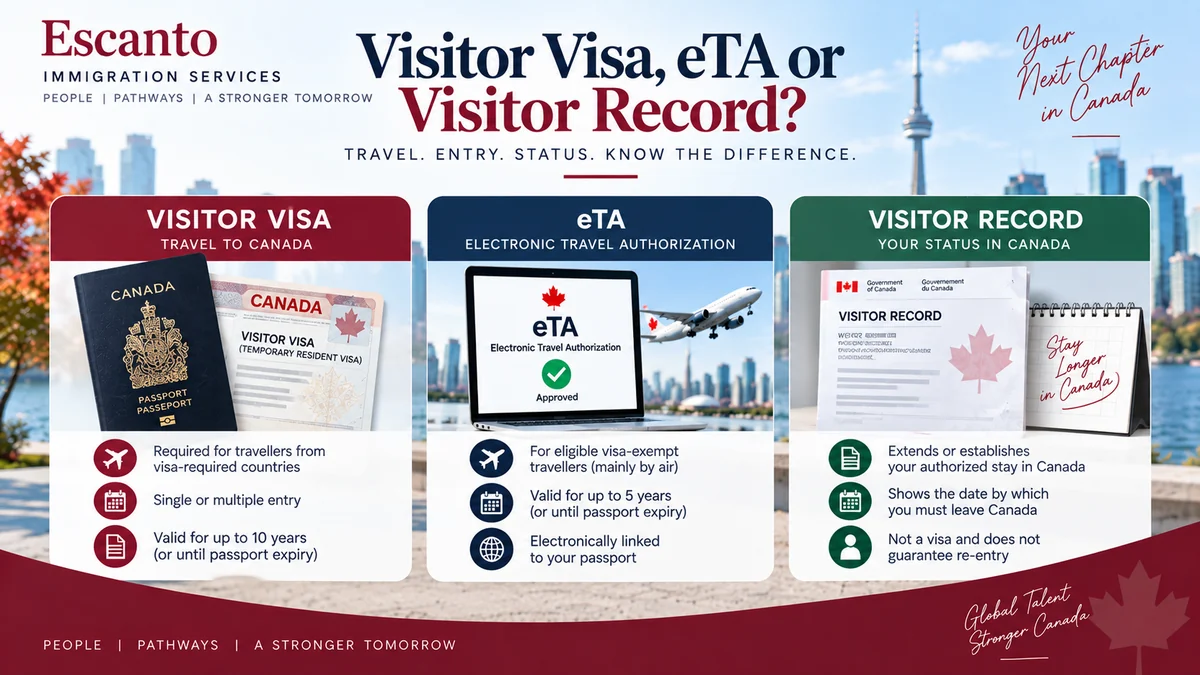
Canadian temporary-residence terminology can be confusing.
Someone may say:
- “My visitor visa expires next year.”
- “I have an eTA.”
- “I extended my visa inside Canada.”
- “My visitor record is valid for another six months.”
These statements can refer to very different immigration documents.
Three documents in particular are often confused:
- Visitor visa, also called a Temporary Resident Visa or TRV
- Electronic Travel Authorization, or eTA
- Visitor record
The basic distinction is:
A visitor visa or eTA generally allows an eligible traveller to travel to Canada and seek entry.
A visitor record generally establishes or extends how long a temporary resident is authorized to remain in Canada.
A visitor record is expressly not a visa.
Understanding that distinction becomes particularly important when someone:
- wants to visit Canada;
- intends to extend a visit;
- changes from worker or student status to visitor status;
- leaves Canada after receiving a visitor record; or
- needs to return to Canada after travelling abroad.
What is a Canadian visitor visa?
A visitor visa, formally called a Temporary Resident Visa (TRV), is the document normally required by citizens of visa-required countries to travel to Canada.
IRCC places the visa in the traveller’s passport.
It indicates that the person met the applicable requirements to travel to Canada at the time the visa was issued.
A visitor visa may be issued as:
- a single-entry visa; or
- a multiple-entry visa.
IRCC decides which type and what validity period to issue based on the circumstances of the application.
A visitor visa is primarily a travel document
One of the most important principles is:
The expiry date on a visitor visa is not normally the date by which the visitor must leave Canada.
Instead, the visa expiry date generally tells the traveller the last date on which that visa can be used to travel to Canada and seek entry.
The period the traveller is actually authorized to remain in Canada is determined separately.
How long can a visitor visa be valid?
IRCC currently states that a visitor visa may generally be issued for up to 10 years, although its validity cannot normally extend beyond applicable limits such as the expiry of the passport or biometrics, and an officer may issue it for a shorter period depending on the circumstances.
That does not mean the traveller can remain continuously in Canada for 10 years.
Visa validity and authorized stay are different concepts.
How long can someone stay after entering Canada?
Most visitors are admitted for up to six months, although a border services officer may authorize a shorter or longer period depending on the circumstances.
The officer may:
- stamp the passport with a departure date; or
- issue a visitor record showing the date by which the person must leave.
The authorized stay therefore needs to be distinguished from the expiry date printed on the visa.
Example
Suppose a visitor visa is valid until:
December 1, 2029
and the person enters Canada on:
June 1, 2027
The December 2029 visa expiry does not mean the person can remain continuously in Canada until December 2029.
Unless the border officer authorizes something different, the visitor would ordinarily be admitted for the applicable temporary period associated with that particular entry.
What is an eTA?
An Electronic Travel Authorization (eTA) is an electronic entry requirement principally used by visa-exempt foreign nationals who travel to Canada by air.
It is electronically linked to the traveller’s passport.
There is normally no physical visa sticker or separate document placed in the passport.
How long is an eTA valid?
An approved eTA is generally valid for:
- up to five years; or
- until the passport linked to the eTA expires,
whichever occurs first.
If the traveller obtains a new passport, a new eTA will normally be required because the authorization is electronically linked to the passport used in the eTA application.
An eTA is mainly relevant to air travel
For ordinary visa-exempt travellers, an eTA is generally required when:
- flying to Canada; or
- transiting through a Canadian airport.
Visa-exempt travellers arriving by land or sea generally do not require an eTA, although they still require appropriate identification or travel documents.
This is why the method of travel can affect which document is required.
Visitor visa or eTA: normally one or the other
IRCC states that a traveller generally needs either:
a visitor visa
or
an eTA
rather than both.
Which requirement applies depends on factors including:
- nationality;
- travel document;
- citizenship;
- method of travel;
- immigration status; and
- in some cases, previous Canadian or U.S. visa history.
The correct document should therefore be checked according to the individual traveller.
Some visa-required nationals can now use an eTA for air travel
There is an important exception to the ordinary visa-required/visa-exempt distinction.
Citizens of certain countries that are normally visa-required may qualify to use an eTA instead of a visitor visa when travelling to Canada by air if they satisfy additional conditions.
IRCC currently requires such travellers to:
- hold a passport from an eligible country;
- be travelling to Canada by air or transiting through a Canadian airport;
- be coming for a temporary stay; and
- either have held a Canadian visitor visa within the previous 10 years or currently hold a valid U.S. non-immigrant visa.
In 2026, Canada added Indonesia and Malaysia to this expanded eTA eligibility framework.
This can be particularly relevant to prospective visitors from those countries.
But the mode of travel still matters
An eligible traveller from one of these selected visa-required countries may use an eTA to fly to Canada.
However, IRCC currently states that the traveller generally still needs a visitor visa when entering Canada by:
- car;
- bus;
- train; or
- boat, including a cruise ship.
Therefore:
eTA eligibility for air travel does not necessarily eliminate the visitor-visa requirement for land or sea travel.
What is a visitor record?
A visitor record is different from both a visitor visa and an eTA.
IRCC describes a visitor record as a document that can:
- extend a person’s authorized stay in Canada;
- establish or modify conditions during the stay; and
- specify the date by which the person must leave Canada.
A visitor record is therefore primarily a status document, not a travel authorization.
A visitor record is not placed in the passport
Unlike a visitor visa counterfoil, a visitor record is normally issued as a separate immigration document.
It contains an expiry date.
That date generally represents the new deadline by which the visitor is expected to leave Canada unless another lawful status application is made.
Who might need a visitor record?
A visitor record can be relevant where someone wants to:
Extend a visit
A visitor already in Canada wants to remain beyond their existing authorized stay.
Change from worker to visitor
A work permit holder will stop working but wants to remain temporarily in Canada as a visitor.
Change from student to visitor
A student will stop studying but wants to remain in Canada temporarily.
Extend certain permit-exempt temporary status
IRCC also identifies certain workers authorized to work without a permit and students authorized to study without a permit as potentially requiring a visitor record to extend their stay.
A visitor record does not authorize re-entry
This is one of the most important distinctions in this article.
A visitor record shows that the person has temporary visitor status in Canada and establishes how long they may remain.
It does not itself guarantee that the person can:
- leave Canada; and
- return using that visitor record.
IRCC expressly states that a visitor record does not guarantee re-entry.
A person travelling abroad must separately meet the entry-document requirements applicable to them.
Visitor visa vs. visitor record
This distinction causes considerable confusion.
| Issue | Visitor Visa | Visitor Record |
|---|---|---|
| Main purpose | Travel to Canada and seek entry | Extend or establish authorized stay in Canada |
| Also called | Temporary Resident Visa / TRV | Visitor Record |
| Physical document | Usually counterfoil in passport | Separate immigration document |
| Shows when you must leave Canada? | Generally no | Yes |
| Extends visitor status inside Canada? | No | Yes |
| Guarantees entry? | No | No |
| Used primarily for re-entry after travel? | Yes, for visa-required travellers | No |
| Can be issued at border? | Travel document obtained through applicable process | Yes, in some circumstances |
| Can be issued after an in-Canada extension? | Not as the status-extension document | Yes |
IRCC specifically describes the visitor visa expiry date as different from the expiry of the person’s authorized stay, while a visitor record contains the date by which the person must leave.
eTA vs. visitor record
The distinction is equally important for visa-exempt travellers.
An eTA normally allows an eligible traveller to board a flight to Canada and seek entry.
A visitor record regulates or extends the period the person is authorized to remain after they are in Canada.
| Issue | eTA | Visitor Record |
|---|---|---|
| Main function | Air-travel authorization | Temporary-status document |
| Linked to passport | Yes | No |
| Physical visa sticker | No | No |
| Typical maximum validity | Up to 5 years or passport expiry | Based on authorized stay |
| Determines how long you may remain after an extension | No | Yes |
| Used to board a flight to Canada | Yes, where required | No |
| Guarantees admission to Canada | No | No |
An eTA is electronically linked to the traveller’s passport and can generally be used for repeated air travel while valid.
Neither a visa nor an eTA guarantees entry to Canada
A valid visitor visa or eTA allows the traveller to present themselves for examination at the Canadian border.
It does not create an unconditional right to enter Canada.
For eTA travellers, IRCC expressly states that an eTA does not guarantee entry and that the traveller must satisfy the border services officer that they remain eligible to enter Canada.
The same principle applies to a visitor visa.
At the border, officers may consider factors such as:
- identity and travel documents;
- purpose of travel;
- admissibility;
- financial resources;
- intended duration;
- immigration history; and
- whether the person will leave Canada at the end of the authorized stay.
A visitor visa does not establish immigration status for its entire validity
Consider someone with a multiple-entry visa valid for five years.
The visa permits repeated travel to Canada during its validity, subject to admissibility and examination at each entry.
It does not mean the person has five years of continuous visitor status inside Canada.
Each entry involves a new assessment and a new authorized period of temporary stay.
The visitor must leave or properly extend that status before the applicable authorized period ends.
An eTA also does not give five years of continuous visitor status
The same misconception sometimes arises with eTAs.
An eTA may remain valid for up to five years, but that validity relates to the travel authorization.
IRCC states that travellers with a valid eTA may travel to Canada repeatedly for short stays, normally up to six months at a time, subject to border examination.
Therefore:
five-year eTA validity ≠ five-year authorized stay in Canada
When should someone apply for a visitor record?
IRCC recommends applying for a visitor record at least 30 days before the current authorized status expires.
The relevant expiry date may be shown on:
- the passport entry stamp;
- a current visitor record;
- a study permit; or
- a work permit.
If no passport stamp was provided at ordinary entry, the authorized stay is commonly based on the period established under the applicable entry rules.
Applicants should not use the expiry date of the visitor visa as though it were necessarily the expiry date of their visitor status.
What happens if the visitor-record application is submitted before status expires?
If an eligible visitor applies to extend their stay before the authorized period expires, IRCC states that they can legally remain in Canada until IRCC makes a decision on the extension application.
This is known as maintained status.
For a fuller explanation, see Maintained Status vs. Restoration of Status in Canada: What Happens When Your Status Expires?
What if the visitor waits until after status expires?
Once temporary resident status has already expired, the issue is no longer simply an ordinary visitor extension.
The person may need to consider restoration of status, if eligible and still within the applicable restoration period.
Restoration and maintained status are materially different.
A late application should therefore not be treated as though it were simply an ordinary visitor-record application submitted on time.
Workers and students can become visitors
A visitor record is not limited to someone who originally entered Canada as a tourist.
IRCC specifically allows eligible:
- work permit holders; and
- study permit holders
to apply to change their temporary resident category to visitor.
This can be useful where, for example:
- employment has ended;
- studies have ended;
- the person needs additional time before leaving Canada;
- another immigration process is underway but does not itself grant temporary status; or
- the individual simply wants to remain temporarily as a visitor.
However, becoming a visitor generally does not preserve work or study authorization.
Visitor status does not normally authorize employment
Being legally present in Canada as a visitor does not ordinarily create authorization to work.
A person who changes from worker status to visitor status should therefore distinguish between:
permission to remain in Canada
and
permission to work in Canada.
They are different immigration authorizations.
Likewise, a visitor record does not itself create unrestricted study authorization.
What if a worker or student needs to travel abroad?
This is another situation where the distinction becomes important.
Suppose a worker has:
- a valid work permit; but
- an expired visitor visa.
The work permit may authorize the person to work and remain in Canada, but the work permit itself is not necessarily sufficient to board an international flight back to Canada.
A visa-required worker planning to leave and return may need a new visitor visa.
IRCC specifically provides an in-Canada process for certain valid work- and study-permit holders who need a new visitor visa for future travel.
The same principle is why a visitor record should not be treated as an international travel document.
Visitor visa, status and work authorization are separate questions
Temporary residents should often ask three separate questions:
1. Can I travel to Canada?
This may depend on:
- visitor visa;
- eTA;
- passport;
- permanent resident travel documentation; or
- another applicable travel document.
2. Can I remain in Canada?
This depends on the person’s temporary resident status and authorized period of stay.
A visitor record may be relevant.
3. Can I work or study?
This depends on the appropriate:
- work permit;
- study permit;
- permit exemption; or
- other specific authorization.
One immigration document does not necessarily answer all three questions.
Example 1: Visitor visa holder extending a stay
A visa-required traveller receives a visitor visa valid until 2029.
They enter Canada in 2027.
They want to remain beyond the period authorized at entry.
They do not apply to “extend the visa” merely because they want to stay longer.
Instead, they apply for a visitor record to extend their visitor status inside Canada.
Their visitor visa may remain valid separately for future travel.
Example 2: eTA traveller extending a stay
A visa-exempt traveller flies to Canada with a valid eTA.
Once in Canada, they decide they need additional time.
They do not extend the eTA to extend their stay.
They apply for a visitor record before their existing status expires.
The eTA remains a separate travel authorization.
Example 3: Visitor record holder leaving Canada
A visitor is granted a visitor record extending status until December 31.
They leave Canada in October and later want to return.
The visitor record alone does not guarantee re-entry.
The traveller must meet the applicable Canadian entry requirements and possess the appropriate travel document—such as a valid visitor visa or eTA where required.
Example 4: Work permit holder becoming a visitor
A temporary worker decides not to continue working in Canada when the work permit ends.
Before expiry, the person applies to change status to visitor.
If approved, IRCC issues a visitor record.
That document authorizes the temporary stay as a visitor according to its terms.
It does not continue the previous work authorization.
Example 5: Visitor visa valid but status expiring
A person entered Canada five months ago.
Their visitor visa remains valid for another four years.
That does not automatically mean they can remain in Canada for another four years.
If their authorized visitor status is approaching expiry and they wish to stay longer, the relevant application is a visitor-record extension.
Visa-required travellers
A visa-required traveller generally needs a valid visitor visa to travel to Canada, subject to specific exemptions and the expanded eTA program available to certain eligible nationalities travelling by air.
The traveller must still satisfy the applicable temporary-residence requirements.
For a visitor visa, IRCC currently requires applicants to establish factors including:
- valid travel documentation;
- admissibility;
- sufficient funds;
- ties relevant to their circumstances; and
- an intention to leave Canada at the end of the authorized visit.
Visa-exempt travellers
Many visa-exempt foreign nationals need an eTA when travelling to Canada by air.
However, they generally do not need an eTA merely because they arrive at a land border or by sea.
The traveller still needs appropriate identification and must satisfy the requirements for admission to Canada.
U.S. citizens and U.S. permanent residents are treated differently
U.S. citizens are generally exempt from both the visitor visa and eTA requirement and travel with appropriate identification such as a valid U.S. passport.
Lawful permanent residents of the United States are also exempt from the eTA requirement but must carry the required passport or travel document and proof of lawful U.S. permanent resident status.
These are specific exemptions and should not be generalized to all residents of the United States.
Canadian permanent residents do not use visitor visas or eTAs
A Canadian permanent resident does not ordinarily travel to Canada using an eTA or visitor visa.
IRCC states that permanent residents travelling commercially should instead use:
- a valid PR card; or
- where applicable, a Permanent Resident Travel Document.
Permanent resident status also does not simply disappear because a PR card expires.
This issue is separate from temporary visitor documentation.
Common misunderstandings
“My visitor visa is valid until 2030, so I can stay until 2030.”
Incorrect.
The visa validity concerns use of the travel document, not continuous visitor status inside Canada.
“My visitor visa expired while I was in Canada, so my status automatically expired.”
Not necessarily.
Visa validity and authorized temporary status are separate questions.
The relevant authorized stay may be established by the entry date, passport stamp, visitor record or another immigration document.
“I extended my visitor visa from inside Canada.”
Usually what the person actually extended was visitor status through a visitor record.
A new visa may be required separately if the person later intends to travel and return.
“A visitor record lets me travel back to Canada.”
No.
A visitor record is not a visa and does not guarantee re-entry.
“An eTA lets me stay in Canada for five years.”
No.
An eTA may remain valid for up to five years, but visitors are normally admitted for temporary stays, often up to six months at a time.
“If I have a visa, Canada must admit me.”
No.
A visa allows the traveller to present themselves for examination at the border. Admission remains subject to the border examination and admissibility requirements.
“Visa-exempt means I need no immigration authorization.”
Not necessarily.
Many visa-exempt travellers flying to Canada require an eTA.
“Everyone from a visa-required country must always have a visa.”
Not necessarily.
Citizens of certain designated visa-required countries may qualify for an eTA for air travel if they meet the additional requirements.
Quick comparison
| Document | Main purpose | Typical user | Validity / effect |
|---|---|---|---|
| Visitor visa / TRV | Travel to Canada and seek entry | Visa-required traveller | Can be issued for multiple trips during validity |
| eTA | Air travel to Canada and transit through Canadian airports | Primarily visa-exempt traveller | Up to 5 years or passport expiry |
| Visitor record | Extend or establish temporary stay in Canada | Person already in Canada or issued one at entry | Until date shown on document |
The three documents solve different immigration problems.
Which document do you need?
A useful way to determine the answer is to ask:
Are you outside Canada and planning to travel here?
Determine whether you need:
- a visitor visa;
- an eTA;
- or neither, based on your nationality, travel document and transportation method.
Are you already in Canada and want to stay longer as a visitor?
A visitor record is generally the relevant document.
Are you in Canada with a work or study permit and want to become a visitor?
You may need to apply for a visitor record before your existing status expires.
Do you already have visitor status but want to travel outside Canada and return?
Check whether you have the required visitor visa or eTA for the return journey.
Do not rely on the visitor record alone.
Practical checklist
Before travelling to or remaining in Canada, confirm:
- What passport or travel document will you use?
- Are you from a visa-required or visa-exempt country?
- Are you travelling by air, land or sea?
- Do you need a visitor visa?
- Do you need an eTA?
- If you are from a selected visa-required country, do you qualify for the special eTA option for air travel?
- Is the visitor visa or eTA still valid?
- When did you enter Canada?
- What period of stay did the border officer authorize?
- Was your passport stamped?
- Were you issued a visitor record?
- What is the actual expiry date of your current temporary status?
- Do you need to remain in Canada beyond that date?
- If so, have you applied for a visitor record before expiry?
- Are you planning international travel while holding a visitor record?
- Do you have the correct travel document for re-entry?
- Are you also working or studying, and if so, do you have separate authorization for that activity?
The key distinction
The simplest way to remember the difference is:
Visitor visa = travel to Canada
eTA = electronic authorization for qualifying air travel
Visitor record = permission to remain in Canada until a specified date
These functions can overlap within one person’s immigration history, but the documents should not be treated as interchangeable.
For broader visitor application requirements, see Canada Visitor Visa Applications: Purpose of Travel, Funds and Supporting Documents.
Applicants travelling for commercial purposes should also review Business Visitor or Work Permit? Understanding the Difference in Canada.
Parents and grandparents planning extended family visits can review Parent and Grandparent Super Visa in Canada: Eligibility, Income, Insurance and Sponsorship.
For situations involving both temporary and permanent immigration plans, see Dual Intent in Canadian Immigration: Temporary Residence While Pursuing Permanent Residence.
Escanto Immigration Services assists with Visitors & Business Visitors matters, including visitor visas, visitor records, business visits, Super Visas and temporary-residence planning.
For advice based on your nationality, travel history, current status and intended visit, book a consultation.
Explore more Canadian immigration guidance in Escanto Insights.
Official sources
- IRCC — Visit Canada
- IRCC — Visitor visa: About the document
- IRCC — Electronic Travel Authorization eligibility
- IRCC — eTA for citizens of selected visa-required countries
- IRCC — Visitor record: About the document
- IRCC — Visitor record eligibility and when to apply
- IRCC — Travelling outside Canada with a visitor record