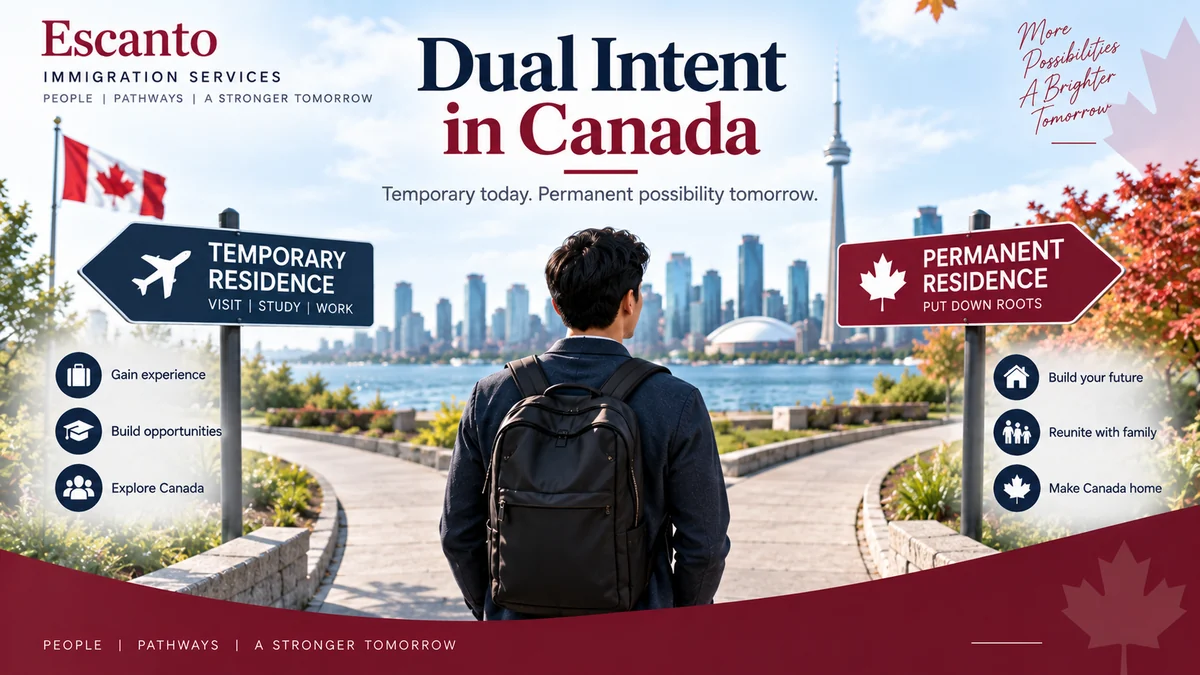
What does dual intent mean in Canadian immigration?
Canadian immigration law recognizes that a foreign national may have two immigration intentions at the same time:
- a temporary intention to come to Canada as a visitor, student or worker; and
- a longer-term intention to become a permanent resident.
This is commonly called dual intent.
Section 22(2) of the Immigration and Refugee Protection Act expressly provides that an intention to become a permanent resident does not prevent someone from becoming a temporary resident, provided the immigration officer is satisfied that the person will leave Canada at the end of the period authorized for their stay.
That means wanting to immigrate permanently to Canada is not, by itself, inconsistent with applying for temporary residence.
The applicant must nevertheless satisfy the requirements applicable to the temporary application.
Dual intent is legal
Dual intent is not a loophole or an exception created informally by immigration officers.
It is expressly recognized in Canadian immigration legislation.
The Immigration and Refugee Protection Act states that an intention to become a permanent resident does not preclude temporary residence where the officer is satisfied that the applicant will leave Canada by the end of the authorized period if required to do so.
IRCC’s own guidance similarly describes dual intent as a situation in which a foreign national may be seeking temporary entry while also having applied—or intending to apply—for permanent residence.
The existence of permanent-residence plans should therefore not automatically result in refusal of a temporary-residence application.
Dual intent does not eliminate the temporary-residence test
The other side of the rule is equally important.
A person who wants permanent residence must still satisfy the officer that they will comply with the conditions of temporary residence.
For a visitor visa, IRCC currently requires applicants to convince the officer that they will leave Canada at the end of their visit and that they have sufficient financial resources for the stay. IRCC may also consider ties such as employment, property, financial assets and family.
So dual intent does not mean:
“I plan to live in Canada permanently, therefore I no longer need to establish temporary intent.”
Instead, the correct concept is closer to:
“I may ultimately pursue permanent residence, but if that does not occur, I understand that I must comply with my temporary status and leave Canada when required.”
Temporary intent and permanent intent can coexist
At first glance, the concepts may appear contradictory.
A person might reasonably ask:
How can someone intend both to leave Canada and to remain permanently?
The answer is that the intentions are conditional.
The applicant may intend to remain permanently if Canadian immigration law eventually permits them to do so, while also being prepared to leave if permanent status is not granted.
IRCC guidance emphasizes that officers should distinguish between a person whose dual intentions are genuine and someone who has no intention of leaving Canada if permanent residence is refused.
That distinction is central to a dual-intent assessment.
Who can have dual intent?
Dual intent can arise in many immigration situations.
It is not limited to one immigration program.
Common examples include:
- a visitor who has also applied for family sponsorship;
- a spouse visiting a Canadian partner while permanent residence is pending;
- an international student who hopes to qualify for permanent residence after graduation;
- a temporary foreign worker who intends to apply through Express Entry or a provincial program;
- an entrepreneur visiting Canada while considering a future immigration pathway;
- a parent or grandparent visiting family while considering permanent family reunification where available.
IRCC guidance gives examples including a person who frequently visits a Canadian spouse while complying with previous temporary conditions and a person who has applied or intends to apply for permanent residence while visiting Canada for temporary purposes.
Dual intent and visitor visas
Dual intent frequently arises in visitor visa applications.
A person may want to visit Canada even though they also have:
- a spouse or partner in Canada;
- children in Canada;
- a pending permanent-residence application;
- an Express Entry profile;
- a provincial nomination;
- or plans to immigrate later.
None of those factors automatically disqualifies the person from obtaining a visitor visa.
However, IRCC still requires a visitor visa applicant to establish that the visit is genuinely temporary and that the applicant will leave Canada when the authorized stay ends if permanent status has not been obtained.
Having family in Canada is not automatically negative
Family connections in Canada can be both relevant and understandable.
For example, a spouse with a pending sponsorship application may reasonably want to visit their Canadian partner during processing.
IRCC has publicly acknowledged dual intent in the spousal context and has stated that temporary-residence applications are assessed on their individual facts.
The relevant question remains whether the applicant will comply with temporary-residence conditions if the permanent application does not result in status.
Dual intent and spousal sponsorship
One of the clearest examples is a foreign spouse or common-law partner who has been sponsored for permanent residence but also wants to visit Canada.
The permanent-residence application demonstrates a clear long-term intention to immigrate.
That does not automatically prevent a temporary visit.
IRCC’s application guidance specifically provides a visitor-visa application route for a person coming to Canada to visit a spouse or partner who has sponsored them for permanent residence.
The applicant must still satisfy the temporary-residence requirements.
A pending sponsorship application should therefore be disclosed rather than concealed.
Dual intent does not mean hiding permanent-residence plans
Applicants should not attempt to manufacture temporary intent by concealing relevant permanent-residence plans.
If an applicant:
- has filed a sponsorship application;
- has an active Express Entry profile;
- has received a provincial nomination;
- has submitted a permanent-residence application; or
- has another material immigration process underway,
the temporary-residence application should be accurate and truthful.
Dual intent exists precisely because Canadian law recognizes that both intentions may coexist.
Trying to hide a permanent-residence objective can create greater credibility concerns than addressing it openly.
Why disclosure matters
Canadian immigration applications require truthful and complete information.
A person should not falsely state that they have no intention of immigrating permanently if there is already a genuine permanent-residence plan.
The better approach is usually to explain:
- the temporary purpose of the present visit;
- the permanent-residence intention, where relevant;
- the applicant’s understanding of the temporary conditions;
- why the applicant will comply with those conditions; and
- what the applicant will do if permanent residence is not approved.
This allows the officer to assess the actual circumstances rather than an artificial narrative.
What does an officer consider?
There is no single dual-intent checklist that guarantees approval.
IRCC assesses temporary-residence applications on their individual facts.
Depending on the case, relevant considerations may include:
- purpose of travel;
- length of intended stay;
- financial support;
- employment;
- family ties inside and outside Canada;
- property and financial assets;
- previous immigration history;
- compliance with previous visas or permits;
- previous travel history;
- the stage of any permanent-residence application;
- whether the applicant has respected previous immigration conditions; and
- whether the person appears likely to leave Canada if required.
IRCC’s visitor guidance specifically identifies ties such as employment, home, assets and family, together with financial resources and the requirement to leave at the end of the authorized visit.
IRCC’s dual-intent guidance also emphasizes the distinction between a genuine temporary intention and a person who would not leave Canada if permanent residence were refused.
Strong home-country ties are relevant, but they are not the whole analysis
Applicants often focus heavily on proving “ties” outside Canada.
Those ties can be important.
Examples can include:
- employment;
- business ownership;
- property;
- dependent family members;
- education;
- financial obligations;
- professional responsibilities; and
- community connections.
But dual-intent assessment should not be reduced to a mechanical checklist of property ownership or employment.
The overall circumstances must make sense.
For example, a retired parent visiting an adult child may naturally have fewer employment ties than a younger professional.
The evidence should reflect the applicant’s actual life circumstances.
A permanent-residence application can sometimes make the temporary story more understandable
A pending permanent-residence application does not necessarily undermine a temporary-residence application.
In some circumstances, it may explain why the person wants to visit Canada temporarily.
For example:
- a sponsored spouse may want to spend time with their partner while PR processing continues;
- a parent may want to visit family while a longer-term immigration option is being considered;
- a skilled worker may be temporarily employed in Canada while pursuing economic immigration;
- an international student may intend to gain education and then lawfully pursue available post-graduation options.
The key issue is not whether the person would prefer to stay in Canada permanently.
The question is whether the person will respect the limits of temporary status unless and until permanent status is lawfully granted.
Dual intent for international students
International students are a common dual-intent group.
A student may genuinely intend to:
- study in Canada temporarily;
- possibly obtain a Post-Graduation Work Permit if eligible;
- gain Canadian work experience; and
- later seek permanent residence through an available program.
Those longer-term possibilities do not automatically make the original study permit application inconsistent.
IRCC has previously stated that there is no inherent inconsistency between an international student program that offers pathways to permanent residence and the requirement that a student remain a bona fide temporary resident.
The student must still establish the genuine purpose of study and meet the applicable study-permit requirements.
For more on study applications, see Applying for a Canadian Study Permit: What Applicants Should Prepare.
Dual intent for temporary foreign workers
Workers can also have dual intent.
A foreign national may temporarily work in Canada while simultaneously:
- maintaining an Express Entry profile;
- pursuing a Provincial Nominee Program;
- preparing a Canadian Experience Class application;
- participating in an employer-supported immigration pathway;
- or pursuing another permanent-residence route.
The existence of those permanent-residence plans does not itself invalidate temporary worker status.
The worker must still comply with:
- the work permit;
- employer or occupation restrictions where applicable;
- the validity period;
- and the requirement to maintain lawful temporary status.
For a broader explanation of work authorization, see Open vs. Employer-Specific Work Permits in Canada: What Is the Difference?
Dual intent and Express Entry
Creating an Express Entry profile demonstrates interest in permanent residence.
It does not, by itself, transform a visitor, worker or student into a permanent resident.
A person in the Express Entry pool remains subject to whatever temporary status they currently hold.
Likewise, receiving an Invitation to Apply or submitting a permanent-residence application does not automatically extend a temporary permit.
Temporary status and permanent-residence processing should therefore be managed separately.
For the structure of Express Entry, see How Express Entry Works in Canada: Eligibility, CRS and the Application Process.
Dual intent does not create immigration status
This distinction is important.
Dual intent is a legal concept governing how intentions are assessed.
It does not itself provide:
- visitor status;
- a study permit;
- a work permit;
- maintained status;
- permanent residence;
- or authorization to remain in Canada after temporary status expires.
A person must still maintain valid immigration status through the appropriate process.
For example, someone with a permanent-residence application in progress may still need to:
- extend a work permit;
- extend a study permit;
- apply for a visitor record;
- obtain another qualifying work authorization; or
- leave Canada when required.
A pending permanent-residence application is not automatically a temporary-status extension.
Dual intent and maintained status are different concepts
Dual intent and maintained status are sometimes confused because both can involve someone remaining temporarily in Canada while another immigration process continues.
They are different.
Dual intent concerns the person’s intention to be both a temporary resident now and potentially a permanent resident later.
Maintained status concerns the legal continuation of temporary resident status after a qualifying extension application was submitted before the previous status expired.
For more on that distinction, see Maintained Status vs. Restoration of Status in Canada: What Happens When Your Status Expires?
A visitor visa does not guarantee entry
Even after a visitor visa is issued, entry to Canada is still assessed at the border.
A visitor visa is a travel document indicating that the person met the applicable visa requirements when it was issued. It does not create an unconditional right to enter or remain in Canada.
A border officer may still assess:
- the purpose of the visit;
- admissibility;
- intended length of stay;
- financial support;
- and whether the traveller remains a genuine temporary resident.
Applicants should therefore ensure that their travel plans remain consistent with the information provided in the visa application.
A visitor visa and visitor record are different
This distinction also matters in dual-intent situations.
A visitor visa is generally used to travel to Canada and seek entry.
A visitor record is a document used to extend or establish the authorized period of temporary stay inside Canada.
IRCC explains that a visitor record is not a visa and includes the date by which the person must leave Canada.
A person with a pending permanent-residence application should therefore not assume that the permanent application replaces the need to extend temporary visitor status.
Dual intent does not guarantee temporary-residence approval
This is perhaps the most important practical point.
The fact that dual intent is legally recognized does not mean every dual-intent application must be approved.
The officer must still be satisfied that the applicant meets the temporary-residence requirements.
For visitor applicants, this includes being satisfied that the person will leave Canada at the end of the authorized stay.
An applicant can therefore have lawful dual intent and still be refused if the evidence does not satisfy the temporary-residence requirements.
Common dual-intent misunderstandings
“If I want permanent residence, I cannot apply for a visitor visa.”
Incorrect.
Canadian law expressly recognizes dual intent.
“If dual intent is legal, IRCC cannot refuse my temporary application.”
Incorrect.
The applicant must still establish that the temporary-residence requirements are met, including the requirement to leave when authorized status ends.
“I should hide my PR application because it makes me look less temporary.”
That approach can create credibility problems.
Relevant immigration history should be disclosed truthfully.
“A pending PR application lets me remain in Canada.”
Not necessarily.
A permanent-residence application does not automatically extend visitor, worker or student status.
“Once I have dual intent, I can stay until PR is decided.”
No.
The person must continue to maintain temporary status or leave Canada when required.
“Having a Canadian spouse means I cannot be a genuine visitor.”
Not necessarily.
IRCC guidance specifically recognizes that a person may visit a Canadian spouse while also having a permanent-residence intention, provided the temporary requirements are satisfied.
“Having no job automatically means a visitor visa must be refused.”
No single factor determines the outcome.
The officer assesses the circumstances as a whole, including ties, finances, purpose of travel and immigration history.
What should a dual-intent explanation address?
Where dual intent is clearly relevant, a temporary-residence application may benefit from a concise and credible explanation.
Depending on the circumstances, the applicant may address:
1. The temporary purpose
Why is the person coming to Canada now?
Examples might include:
- visiting a spouse or family member;
- attending a family event;
- studying;
- working under an authorized permit;
- business meetings;
- or another legitimate temporary activity.
2. The intended duration
How long does the person actually plan to remain under the temporary application?
3. The permanent-residence process
If a PR application or pathway exists, describe it accurately rather than pretending it does not.
4. Compliance if PR is unsuccessful
Explain that the applicant understands that temporary status does not guarantee permanent residence and that they must comply with the conditions of their temporary stay.
5. Financial arrangements
Show how the temporary stay will be funded.
6. Immigration history
A history of respecting visa or permit conditions can be relevant.
7. Connections outside Canada
Where relevant, document employment, family responsibilities, business interests, property, education or other continuing obligations.
The explanation should remain factual.
It should not attempt to create artificial ties that do not reflect the applicant’s real circumstances.
Example: sponsored spouse visiting Canada
Consider a foreign national whose Canadian spouse has submitted a family-sponsorship application.
The foreign national also applies for a visitor visa.
There are clearly two intentions:
Permanent intention: live with the Canadian spouse permanently if the sponsorship application is approved.
Temporary intention: visit the spouse now and leave Canada if required before permanent status is granted.
Canadian law allows those intentions to coexist.
The visitor application must nevertheless establish that the person qualifies as a temporary resident.
Example: international student with permanent-residence plans
A student may intend to complete a Canadian education, obtain a PGWP if eligible and later pursue economic immigration.
That longer-term plan does not automatically make the study permit purpose illegitimate.
The student still needs to establish:
- a genuine academic purpose;
- financial capacity;
- compliance with study-permit conditions;
- and temporary-residence requirements.
A future permanent-residence opportunity should be treated as a potential lawful pathway—not as a guaranteed outcome.
Example: worker in Express Entry
Consider a temporary worker with an active employer-specific work permit who also enters the Express Entry pool.
The worker may hope to receive an Invitation to Apply for permanent residence.
Until that happens and permanent status is actually obtained, the person remains subject to the temporary work permit and its conditions.
The Express Entry profile does not replace the work permit.
If the work permit will expire, the worker must determine what temporary-status option is available rather than relying on the permanent-residence intention alone.
Evidence should match the particular applicant
Dual-intent applications should not all use identical explanations.
For example:
A young professional visiting for three weeks may reasonably rely on ongoing employment and approved leave.
A retired parent may rely more heavily on property, pension income, family relationships and a defined visit plan.
A sponsored spouse may explain the pending permanent-residence process and the reason for wanting to spend time with the sponsor during processing.
A student may focus on the educational program, finances and lawful immigration pathway.
The strongest evidence is usually evidence that naturally fits the applicant’s actual circumstances.
Invitation letters should be consistent with dual intent
Where an invitation letter is included, it should accurately describe:
- who is inviting the applicant;
- the relationship;
- the reason for the visit;
- intended duration;
- accommodation arrangements;
- and any financial support being provided.
IRCC states that an invitation letter does not guarantee visa approval and that officers still assess whether the applicant meets Canadian immigration law.
The host’s letter and the applicant’s own explanation should therefore be consistent.
Permanent-residence plans should not be presented as a guaranteed outcome
Another common mistake is writing as though permanent residence has already been secured.
Statements such as:
“I will permanently settle in Canada after I arrive”
can create a different impression from:
“I have a permanent-residence application in process, but I understand that approval is not guaranteed and I will comply with my temporary status.”
The distinction is not merely stylistic.
The second explanation acknowledges the legal uncertainty that exists until permanent residence is actually granted.
Dual intent is compatible with immigration planning
Canada’s immigration system includes many pathways in which temporary residence can precede permanent residence.
Examples include individuals who:
- study in Canada and later qualify for economic immigration;
- work temporarily and later qualify through Canadian experience;
- pursue a provincial nomination;
- visit a Canadian spouse while family sponsorship is processed;
- or participate in another lawful pathway that may eventually lead to permanent residence.
Dual intent allows the immigration system to recognize that reality without eliminating the temporary-residence requirements.
A practical dual-intent checklist
Before submitting a temporary-residence application where permanent-residence plans also exist, consider:
- What temporary status are you applying for?
- What is the genuine temporary purpose?
- How long do you intend to stay?
- Do you already have a permanent-residence application or profile?
- Has that process been disclosed accurately?
- What will you do if the permanent-residence process is refused or delayed?
- What evidence shows you can financially support the temporary stay?
- What ties or responsibilities exist outside Canada?
- What family ties exist inside Canada?
- Have you previously complied with Canadian immigration conditions?
- Does your travel history support the application?
- Are your invitation letter and personal explanation consistent?
- Are you describing permanent residence as a possibility rather than an entitlement?
- Is your current temporary status valid?
- If you are already in Canada, do you need a separate extension before your status expires?
- Does your evidence support your actual circumstances rather than a generic template?
Dual intent should be explained, not feared
An intention to become a permanent resident is not inherently incompatible with temporary residence in Canada.
Canadian law explicitly recognizes the possibility of both intentions existing at the same time.
But dual intent does not remove the applicant’s obligations as a temporary resident.
The applicant still needs to demonstrate a credible temporary purpose and satisfy the officer that they will comply with Canadian immigration law—including leaving Canada when required if permanent residence is not granted.
For broader visitor requirements, see Canada Visitor Visa Applications: Purpose of Travel, Funds and Supporting Documents.
Applicants visiting Canada for commercial activities can also review Business Visitor or Work Permit? Understanding the Difference in Canada.
For temporary-status timing and extensions, see Maintained Status vs. Restoration of Status in Canada: What Happens When Your Status Expires?
Escanto Immigration Services assists with Visitors & Business Visitors matters, temporary-residence applications and immigration planning involving both temporary and permanent pathways.
For advice based on your travel purpose, family circumstances, immigration history and permanent-residence plans, book a consultation.
Explore more Canadian immigration guidance in Escanto Insights.