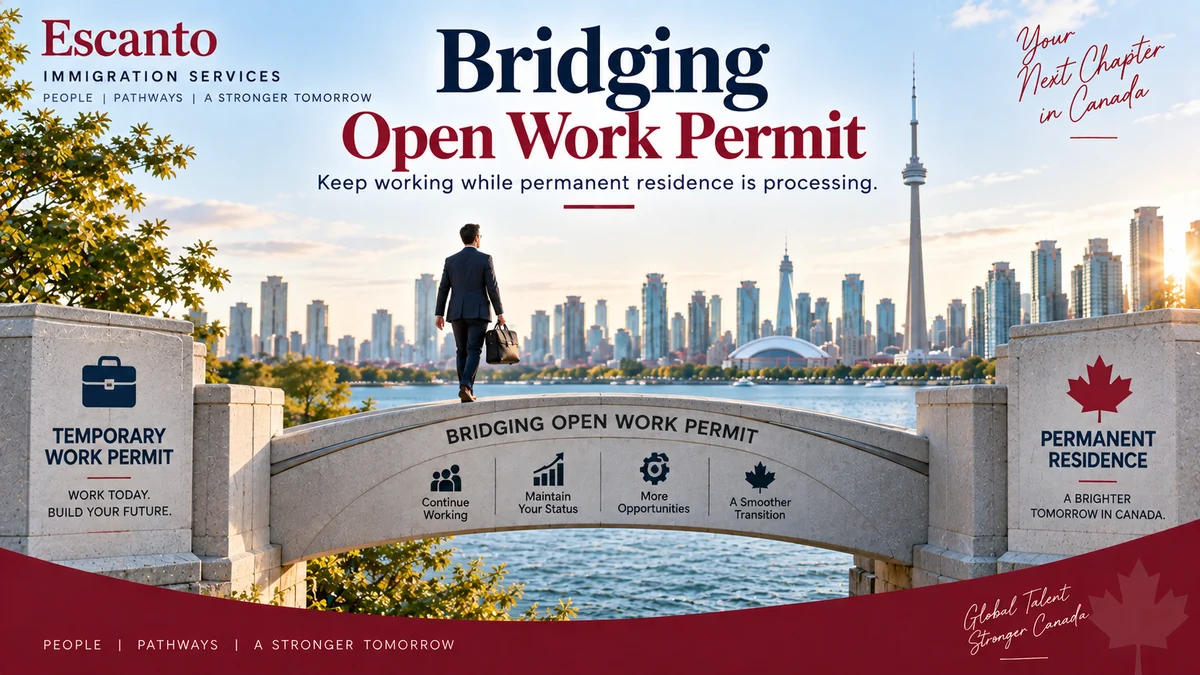
What is a Bridging Open Work Permit?
A Bridging Open Work Permit, commonly called a BOWP, can allow certain foreign nationals to continue working in Canada while Immigration, Refugees and Citizenship Canada processes their permanent residence application.
The permit is called “bridging” because it can help bridge the period between:
an existing temporary work permit
and
a final decision on permanent residence.
Unlike an ordinary employer-specific work permit, a BOWP is an open work permit. Eligible holders are generally not restricted to one specific employer, although all conditions printed on the permit still apply.
A BOWP is not available merely because someone hopes to become a permanent resident.
The applicant must have reached the required stage of an eligible permanent residence process.
A permanent residence plan is not enough
One of the most important distinctions is between:
planning to apply for permanent residence
and
having actually submitted an eligible permanent residence application.
For example, an Express Entry candidate who has only created a profile and entered the pool has not yet submitted a permanent residence application.
IRCC expressly states that submitting an Express Entry profile is not the same as applying for permanent residence for BOWP purposes.
Similarly, receiving an Invitation to Apply does not by itself mean that a BOWP is immediately available.
The permanent residence application must reach the required stage under the applicable program.
Which permanent residence applicants may qualify?
IRCC’s current BOWP framework covers applicants under several permanent residence categories, including:
- Express Entry;
- Provincial Nominee Program;
- Quebec skilled worker class;
- certain older caregiver pilots;
- certain older caregiver classes;
- Agri-Food Pilot; and
- Quebec investor cases.
The requirements are not identical across all programs.
This means there is no single BOWP eligibility test that applies to every permanent residence applicant.
The first question should be:
Which permanent residence program did you apply under?
Express Entry applicants
Express Entry is one of the most common BOWP situations.
IRCC’s BOWP rules apply to permanent residence applications under the Express Entry-managed:
- Federal Skilled Worker Program;
- Canadian Experience Class; and
- Federal Skilled Trades Program.
Who can qualify under Express Entry?
Under the current rules, an Express Entry principal applicant generally needs to:
- live in Canada when applying for the BOWP;
- intend to live outside Quebec;
- have valid temporary resident status and a valid work permit, or
- have maintained status as a worker after the previous work permit expired, or
- be eligible to restore temporary resident status and obtain a work permit;
- be the principal applicant on the permanent residence application;
- have submitted a complete permanent residence application;
- have passed IRCC’s completeness check; and
- have received the Acknowledgement of Receipt (AOR) for the permanent residence application.
The AOR is therefore an important milestone.
What is the Acknowledgement of Receipt?
An Acknowledgement of Receipt, or AOR, confirms that IRCC has received the permanent residence application.
For Express Entry BOWP applications, IRCC specifically requires the applicant to have the AOR issued after submission of the permanent residence application.
The applicant is instructed to include a copy of the AOR with the BOWP application.
For an online application, IRCC currently instructs applicants to upload the AOR through the Client Information field.
An Express Entry profile is not an AOR
These should not be confused.
The sequence is generally:
Express Entry profile → Invitation to Apply → PR application submitted → completeness check → AOR → potential BOWP eligibility
Other requirements still have to be satisfied.
Do you need to wait for your current work permit to expire?
No.
A BOWP is intended to help eligible applicants maintain work authorization while their permanent residence application is being processed.
Applicants should normally address their status before their current work authorization expires rather than deliberately allowing it to lapse.
IRCC specifically cautions applicants who are not yet eligible for a BOWP not to let their work permit expire while waiting to become eligible.
Depending on the circumstances, the worker may instead need to extend their existing employer-specific authorization through:
- a new LMIA; or
- a new LMIA-exempt employer submission,
until BOWP eligibility is established.
For the distinction between these processes, see LMIA vs. LMIA-Exempt Work Permits in Canada: What Employers and Workers Need to Know.
What if the existing work permit has already expired?
An expired permit does not necessarily make every applicant ineligible.
IRCC’s current BOWP rules recognize three possible status situations:
- a valid temporary resident status and valid work permit;
- maintained status as a worker; or
- eligibility to restore status and obtain a work permit.
These situations have very different consequences.
Maintained status
A worker who submitted a qualifying application before the previous permit expired may be able to remain in Canada and, depending on the circumstances, continue working under maintained status.
Restoration
Someone who has already lost status may potentially be eligible to apply for restoration.
Submitting a restoration application does not generally authorize continued employment while restoration is pending.
For a detailed explanation, see Maintained Status vs. Restoration of Status in Canada: What Happens When Your Status Expires?
Provincial Nominee Program applicants
Provincial nominees can also potentially qualify for a BOWP.
However, the requirements depend partly on whether the person applied for permanent residence:
- through Express Entry; or
- through the non-Express Entry Provincial Nominee Program process.
This distinction matters.
Express Entry provincial nominees
A provincial nominee applying through Express Entry is still operating within the Express Entry permanent residence system.
The BOWP assessment therefore involves both:
- the permanent residence application; and
- the provincial nomination.
IRCC’s current BOWP guidance requires supporting documentation including the nomination information and permanent residence AOR where applicable.
Applicants should ensure that the proposed work authorization remains compatible with any conditions attached to the nomination.
Non-Express Entry PNP applicants
For a provincial nominee who applied for permanent residence outside Express Entry, IRCC currently requires, among other things, that the applicant:
- live in Canada and intend to live outside Quebec;
- have valid worker status, maintained worker status, or be eligible for restoration;
- be the principal applicant;
- have no employment restrictions as a condition of the nomination;
- have submitted a complete permanent residence application;
- have passed the required eligibility assessment; and
- have an AOR.
The employment restriction issue is particularly important.
Not every provincial nomination necessarily supports an unrestricted bridging open work permit.
A provincial nomination does not automatically create BOWP eligibility
Receiving a nomination certificate is a major immigration milestone, but it does not itself necessarily mean a BOWP can immediately be issued.
Depending on the PNP stream and application method, IRCC may require:
- the permanent residence application;
- the AOR;
- completion or eligibility assessment;
- nomination documentation; and
- confirmation that the nomination does not contain employment restrictions.
The exact PNP pathway should therefore be identified before submitting a BOWP application.
For a broader explanation of how the two systems interact, see Express Entry and the Provincial Nominee Program: How They Work Together.
Quebec skilled workers
Quebec skilled worker applicants have a separate BOWP framework.
IRCC currently requires an eligible Quebec skilled worker applicant to:
- live in Canada;
- intend to live in Quebec;
- hold a Certificat de sélection du Québec (CSQ) that was valid when the PR application was submitted;
- be the principal applicant;
- have passed the permanent residence completeness check; and
- have valid worker status, maintained status, or eligibility for restoration.
Applicants must also include:
- a copy of the CSQ; and
- the letter containing the permanent residence application number beginning with E.
Quebec cases therefore operate differently from ordinary Express Entry BOWPs.
Agri-Food Pilot applicants
The Agri-Food Pilot has closed to new applications, but some applications remain in processing.
IRCC’s current BOWP guidance still provides a BOWP route for eligible applicants under that pilot.
Among other requirements, the applicant must:
- live in Canada and intend to live outside Quebec;
- satisfy the applicable temporary-status requirement;
- be the principal permanent residence applicant; and
- have received approval in principle for permanent residence.
This illustrates an important point:
Different PR programs require different stages of processing before BOWP eligibility begins.
An AOR may be enough at the required stage for one program while another may require approval in principle.
Caregiver applicants
IRCC’s BOWP page continues to contain provisions for applicants under certain older caregiver programs, including the Home Child Care Provider Pilot and Home Support Worker Pilot that operated from 2019 through 2024.
IRCC specifically states that applicants under the Home Care Worker Immigration pilots opened in 2025 are not eligible for a BOWP under this framework and should review the work permit options applicable to those pilots.
This distinction matters because similarly named caregiver pathways can have different work permit rules.
Quebec investors
Eligible Quebec investor permanent residence applicants may also qualify for a BOWP.
IRCC’s current requirements include:
- having applied for permanent residence as a Quebec investor;
- having passed the completeness check;
- living in Quebec;
- holding, or having held when the PR application was submitted, a valid CSQ;
- being the principal applicant; and
- satisfying the applicable temporary worker status requirement.
Again, supporting documentation differs from an Express Entry BOWP.
A BOWP is an open work permit
One major advantage of the BOWP framework is that the permit is generally open rather than employer-specific.
IRCC defines an open work permit as authorization to work for most employers in Canada, subject to restrictions such as:
- employers listed as non-compliant; and
- certain businesses involving adult entertainment services.
An open permit does not normally require:
- a new LMIA;
- an employer-specific Employer Portal offer; or
- payment of the employer compliance fee by a particular employer.
That can provide considerably greater employment flexibility while the permanent residence application is being processed.
Does a BOWP require a job offer?
Generally, no.
Open work permits are not job-specific, and IRCC states that applicants for open work permits do not need a job offer simply to obtain the open permit.
However, a person’s underlying permanent residence program may itself involve employment, nomination or other eligibility requirements.
The fact that the BOWP is open does not cancel obligations connected with the permanent residence application.
For example, a provincial nominee should consider whether changing employment could affect the nomination.
Can a BOWP holder change employers?
Because the BOWP is an open work permit, the holder is generally not tied to one named employer in the same way as an employer-specific work permit.
That ordinarily provides greater flexibility to change jobs.
However, before changing employment, permanent residence applicants should separately consider whether their PR program depends on:
- a provincial nomination;
- qualifying Canadian work experience;
- an employer-supported pathway;
- an arranged employment condition; or
- another employment-related eligibility requirement.
Work-permit flexibility and permanent-residence eligibility are separate questions.
A person may be legally permitted to change employers under an open work permit while still needing to consider the consequences for the PR application.
Does a BOWP guarantee permanent residence?
No.
A BOWP is temporary work authorization.
It does not mean:
- the PR application has been approved;
- the applicant will necessarily receive permanent residence;
- admissibility has been finally determined; or
- IRCC has completed assessment of every PR requirement.
Its purpose is to allow eligible applicants to maintain work authorization while permanent residence processing continues.
The PR application remains a separate decision.
What happens if the permanent residence application is refused?
A BOWP does not transform into permanent immigration status.
If the PR application is refused, the individual should immediately review:
- the BOWP expiry date;
- whether the BOWP remains valid according to its terms;
- whether another temporary work authorization is available;
- whether reconsideration, judicial review or another immigration application is relevant; and
- when the person must leave Canada if no further legal status exists.
The work permit and the permanent residence application remain separate legal processes.
Can you apply for a BOWP before receiving an Invitation to Apply?
No, not merely because you have an Express Entry profile.
An Express Entry profile places a candidate in the pool.
A BOWP requires an actual permanent residence application that has reached the required processing stage. IRCC expressly distinguishes entering the Express Entry pool from applying for permanent residence.
The sequence generally needs to progress further:
Express Entry profile → ITA → complete PR application → AOR → BOWP eligibility assessment
What if you have received an ITA but have not submitted the PR application?
Receiving an Invitation to Apply still does not, by itself, create a BOWP application basis.
The candidate needs to submit the permanent residence application and reach the required stage.
Someone whose work permit is expiring while preparing the PR application should therefore not assume that the ITA automatically protects work authorization.
A separate temporary-status strategy may be required.
Does an AOR always mean you qualify?
No.
The AOR is an important requirement for several BOWP streams, but it is not the only requirement.
An applicant may still fail to qualify because, for example:
- the PR program is not BOWP eligible;
- the applicant is not the principal applicant;
- the applicant does not satisfy the Canadian residence requirement;
- temporary status requirements are not met;
- a provincial nomination contains employment restrictions;
- the permanent residence application has not reached the required stage; or
- another program-specific condition is missing.
BOWP eligibility should therefore be assessed as a complete set of requirements.
The principal applicant requirement matters
IRCC’s BOWP framework generally requires the person seeking the BOWP to be the principal applicant on the qualifying permanent residence application.
A spouse or common-law partner does not automatically receive a BOWP merely because the principal applicant qualifies.
The spouse may instead need to establish eligibility under the applicable family-member open work permit rules.
Those rules have changed substantially in recent years and depend on the principal applicant’s immigration and employment situation.
For more information, see Spousal Open Work Permits in Canada: Who May Qualify in 2026?
Can your spouse receive an open work permit because you have a BOWP?
Potentially, but not automatically.
Family-member open-work-permit eligibility is governed by a separate framework.
IRCC’s current rules include specific provisions for family members of workers who are on eligible pathways to permanent residence. Eligibility can depend on:
- the principal applicant’s PR pathway;
- current work authorization;
- employment;
- relationship;
- family member’s immigration status; and
- other program-specific requirements.
A spouse should therefore not simply submit an application stating:
“My partner has a BOWP, therefore I automatically qualify.”
The applicable family-member category should be identified first.
How much does a BOWP cost?
Because a BOWP is an open work permit, the standard application generally involves:
- Work permit processing fee: CAD $155
- Open work permit holder fee: CAD $100
That produces a standard total of:
CAD $255
before any applicable biometrics or restoration fees.
If biometrics are required, the current individual biometrics fee is CAD $85.
Government fees can change, so applicants should confirm the fee schedule immediately before submitting.
What if restoration is also required?
Where the applicant has lost worker status but remains eligible for restoration, additional fees apply.
IRCC’s current fee schedule lists restoration as a worker plus a new work permit at CAD $401.25.
Where an open work permit holder fee also applies, applicants should follow the online application instructions and current fee calculator for their specific situation.
More importantly, restoration has consequences for the person’s ability to work while the application is pending.
For that distinction, see Maintained Status vs. Restoration of Status in Canada.
How do you apply?
For the ordinary BOWP process, IRCC instructs applicants to follow the procedure for extending or changing conditions on a work permit.
Applicants should select:
Open work permit
as the type of permit requested and pay both:
- the work permit processing fee; and
- open work permit holder fee.
IRCC states that most applicants must apply online.
Program-specific supporting documents must also be included.
Supporting documents depend on the PR program
Express Entry
Generally include:
- standard work permit documentation; and
- the permanent residence AOR.
Provincial Nominee Program
May require:
- AOR;
- nomination letter; and
- other evidence relevant to the nomination.
Quebec skilled worker
Generally includes:
- CSQ; and
- permanent residence application-number letter.
Certain caregiver or Agri-Food cases
May require:
- approval-in-principle documentation.
The precise requirements should therefore be checked against the BOWP instructions for the applicable PR category.
Can you leave Canada while the BOWP is being processed?
Possibly, but international travel requires caution.
IRCC states that BOWP applicants can leave Canada while the application is being processed.
However, if the person’s existing work permit expires while they are outside Canada—or they leave after it has expired—they cannot simply rely on the pending BOWP application to continue working upon return.
IRCC states that someone returning as a temporary resident in that situation cannot work until the new work permit is approved.
For several BOWP categories, IRCC also states that the applicant must be in Canada with valid temporary resident status when the BOWP decision is made, or the application may be refused.
Travel should therefore be assessed before departure rather than assuming a pending application protects work authorization abroad.
A BOWP is not a travel document
Like other work permits, a BOWP relates to status and work authorization in Canada.
It does not replace the travel documentation required to return to Canada.
Depending on nationality and circumstances, a traveller may separately need:
- a Temporary Resident Visa;
- an eTA; or
- another appropriate travel document.
For the distinction between travel and status documents, see Visitor Visa, eTA or Visitor Record: What Is the Difference in Canada?
What happens while the BOWP application is pending?
If an eligible worker submits the BOWP application before the current work permit expires, the person may be able to remain in Canada under maintained status while IRCC processes the application.
Whether and under what conditions the worker can continue working during that period depends on the maintained-status rules and the person’s previous work authorization.
A pending BOWP application should not be confused with the BOWP itself.
The new open work permit is not issued until IRCC approves the application.
Maintained status before a BOWP is issued
Suppose someone currently holds an employer-specific work permit.
Before that permit expires, they submit an eligible BOWP application.
After the existing permit expires, maintained-status rules may permit continued work while the application is pending.
However, ordinary maintained work authorization generally preserves the conditions of the previous permit until IRCC approves the new open permit.
That means the applicant should not automatically assume that merely submitting the BOWP application immediately converts an employer-specific permit into open work authorization.
The open employment flexibility normally begins when the BOWP itself becomes effective.
For the maintained-status rules, see Maintained Status vs. Restoration of Status in Canada.
Example: Canadian Experience Class applicant
Consider a worker in Canada with an employer-specific permit.
The person:
- qualifies under the Canadian Experience Class;
- receives an Express Entry Invitation to Apply;
- submits the complete permanent residence application;
- receives the AOR after IRCC’s completeness process;
- remains in Canada with eligible worker status; and
- submits a BOWP application before the existing permit expires.
If all BOWP requirements are satisfied, the person may be able to bridge the period between the existing work authorization and the permanent residence decision.
Example: Express Entry profile but no PR application
A worker creates an Express Entry profile and receives a CRS score.
The work permit will expire in two months.
No Invitation to Apply has been received.
That worker does not qualify for a BOWP merely because they are in the Express Entry pool.
They may need another strategy to maintain work authorization, potentially involving:
- an LMIA-based extension;
- an LMIA-exempt employer-specific permit;
- another open work permit category; or
- another available immigration option.
Example: PNP applicant with an employment restriction
A provincial nominee has submitted a permanent residence application.
However, the nomination certificate restricts employment to a particular employer.
The ordinary non-Express Entry PNP BOWP rules require the nomination to have no employment restrictions.
The applicant should therefore not assume that provincial nomination alone creates BOWP eligibility.
Another work permit mechanism may be required.
Example: PR application pending but current permit expired
A permanent residence applicant lets the work permit expire without filing a qualifying extension beforehand.
The person may still potentially qualify for a BOWP if eligible to restore worker status, depending on the PR program and circumstances.
But that is not the same situation as maintained status.
The worker should normally stop working unless and until legally authorized to resume.
Restoration should not be treated as an alternative method of continuing employment without interruption.
Common BOWP mistakes
“I have an Express Entry profile, so I qualify.”
No.
Entering the Express Entry pool is not the same as submitting a permanent residence application.
“I received an ITA, so I can apply for a BOWP.”
Not yet merely because of the ITA.
The PR application must be submitted and reach the required stage.
“My AOR means the BOWP is guaranteed.”
No.
The applicant must satisfy all BOWP eligibility requirements.
“Submitting the BOWP automatically gives me an open work permit.”
No.
The application is still pending until IRCC approves it.
Maintained-status work authorization may operate under the conditions of the previous work permit.
“My spouse automatically receives a BOWP too.”
No.
The BOWP applies to the eligible principal applicant. Family members must qualify under their own applicable work permit rules.
“Because my PR application is pending, I don’t need to extend my temporary status.”
Incorrect.
A permanent residence application does not automatically extend temporary resident status or work authorization.
“I can travel after my work permit expires because my BOWP application is pending.”
This can create a serious work-authorization problem.
IRCC cautions that someone who leaves after the permit expires may not be able to work upon returning until the new permit is approved.
“Any PNP applicant can get a BOWP.”
No.
PNP applicants must satisfy the applicable BOWP requirements, including employment-restriction rules where relevant.
Practical BOWP checklist
Before applying, confirm:
- Have you actually submitted a permanent residence application?
- Which PR program did you apply under?
- Is that program eligible for a BOWP?
- Are you the principal applicant?
- Have you received the required AOR or approval-in-principle document?
- Has the PR application passed the required completeness or eligibility stage?
- Are you currently living in Canada?
- Where do you intend to live—Quebec or outside Quebec?
- Is your current work permit still valid?
- If it expired, do you have maintained status?
- If status was lost, are you eligible for restoration?
- If you are a provincial nominee, does your nomination contain employment restrictions?
- Have you included the required nomination or CSQ documentation?
- Have you paid the work permit and open work permit holder fees?
- Do you need biometrics?
- Are you considering international travel while the application is pending?
- Does changing employers affect your underlying permanent residence program?
- Does your spouse need a separate family-member open work permit assessment?
A BOWP bridges work authorization—not permanent residence eligibility
The central purpose of a Bridging Open Work Permit is continuity.
It can allow an eligible permanent residence applicant to continue participating in the Canadian labour market while IRCC completes the permanent residence process.
But the BOWP should not be treated as:
- proof that permanent residence will be approved;
- a substitute for maintaining temporary status;
- an automatic benefit of entering Express Entry;
- or an automatic work permit for accompanying family members.
The permanent residence application and temporary work authorization continue to operate as separate immigration processes.
For an overview of the permanent residence system, see How Express Entry Works in Canada: Eligibility, CRS and the Application Process.
Provincial nominees can also review Express Entry and the Provincial Nominee Program: How They Work Together.
For work permit distinctions, see Open vs. Employer-Specific Work Permits in Canada: What Is the Difference?
Escanto Immigration Services assists with Work in Canada matters, including bridging open work permits, work permit extensions, permanent-residence-related work authorization and temporary status planning.
For advice based on your PR program, AOR, current work permit and immigration status, book a consultation.
Explore additional Canadian immigration guidance in Escanto Insights.